“Here is the paradox I have lived with for many years: the work belongs neither fully to the artist nor fully to the audience. It exists between them. A painting waits for the viewer. A sonata waits for the listener. A poem waits for the reader who has not yet been born. In that waiting, the work acquires something like agency. It speaks differently to each person who approaches it with care, saying things the artist did not know she had said, meeting needs she could not have anticipated.”
– Makoto Fujimura
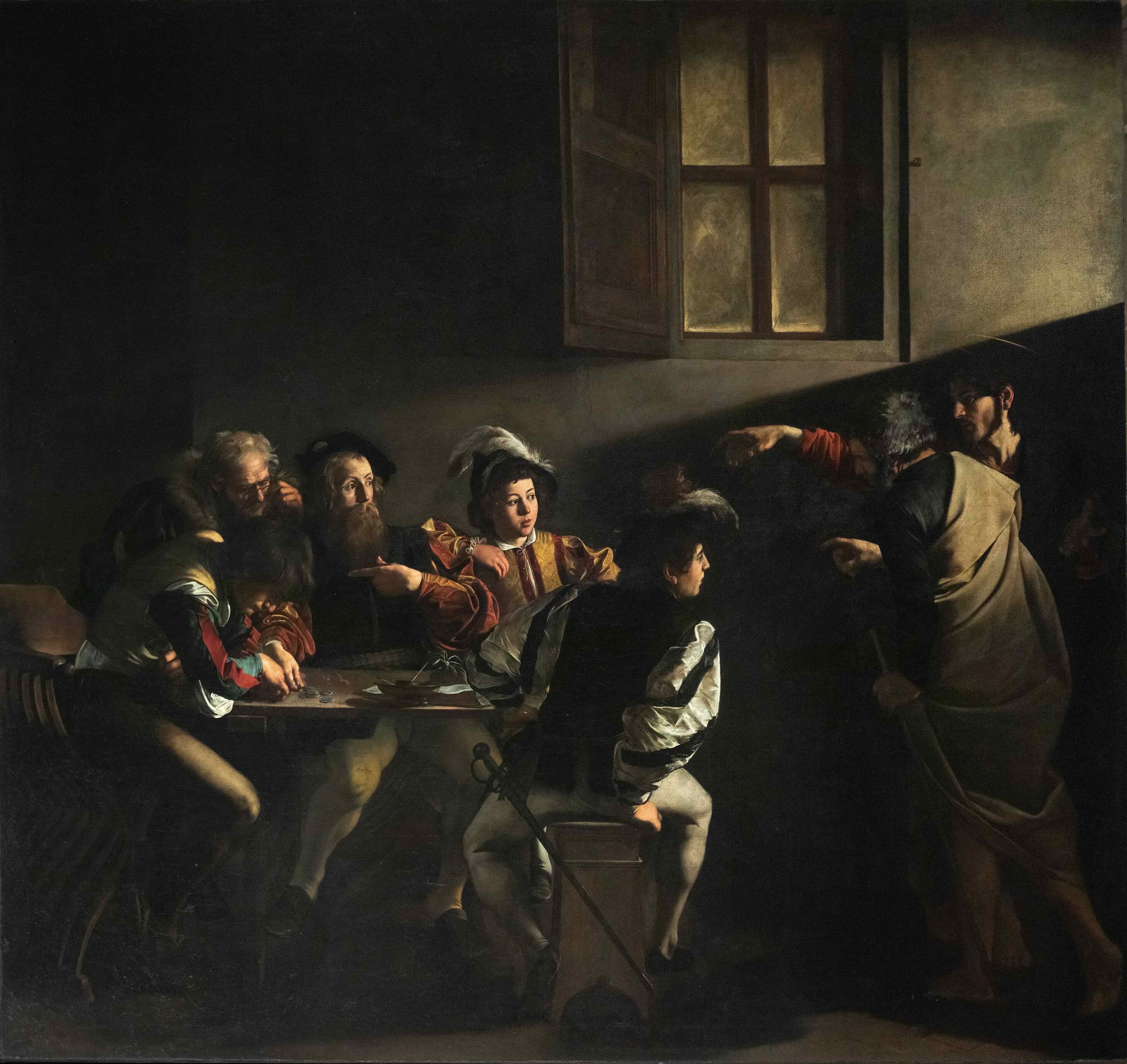
Heading image: Caravaggio (1571−1610), The Calling of Saint Matthew, 1609, oil on canvas, 340 x 322 cm. San Luigi die Francesi, Rome. Public domain via Wikimedia Commons.
A Note from IAMCultureCare
A few weeks ago I lost my voice and watched as the rest of my life crashed around me.
That may sound like a melodramatic overstatement to many readers, and for most people an illness like I picked up would be at worst a painful but soon-forgotten annoyance. In the grand scheme of things it will be that for me, too. But as a singer, with both a concert and pressing church music responsibilities the next day, I spent an anxiety-fueled 24-hours of tea, throat lozenges, and silence to no ultimate avail. That Sunday afternoon found me at home, gloomy and coughing, while my chamber choir colleagues performed a sumptuous program of works by Palestrina, Lassus, Stravinsky, and others — music I had grown to love and which I may never have an opportunity to sing again.
Now, I share that not to garner your pity but rather to pose a question that strikes at the heart of our creative endeavors: What’s the point of it all? Where is the value in the seemingly-wasted weeks of rehearsals I attended late into the night, often when I really would have rather been at home? Ultimately, how do we navigate the tension between a call to make and the fractures that seem to inevitably limit our creativity, the gap between the imagined and the realized?
The relationship between suffering and beauty is complex, and not one which my reflections here will even begin to address. We intuitively (and rightly, I think) want to deny a causal link between the two. It seems wrong to say that suffering is a necessary condition for beauty, or that beauty somehow retrospectively justifies the suffering that it often arises from and stands in contrast to. Elaine Scarry (and Mako and Haejin Fujimura) would argue there is an integral connection between beauty and justice, that true beauty is truly just, and vice versa.
But we also see, again and again, examples of great art coming out of contexts of profound suffering and injustice. Name an enduring work of art and there is a good chance its creator endured some significant trauma with which their work is in conversation. Consider the trenches of the Great War influencing a whole generation of writers creating some of the most haunting and enduring works of poetry and fiction; the scourge of chattel slavery and subsequent (ongoing) struggle for civil rights incubating spiritual, jazz, and gospel idioms, not to mention the great literary works of the Harlem Renaissance; Vincent van Gogh’s troubled mental state coinciding with his most productive period of artistic creativity; the Black Death looming over artists from Fra Angelico to Shakespeare; the 9⁄11 terror attacks catalyzing Makoto Fujimura’s Water Flames paintings. The fracture can be explicit or implicit, directly named or present by its conspicuous absence, but east of Eden there is no work that can be wholly called good.
Instead, there is faithfulness. We cannot escape suffering, but we can choose how to respond, and it is in the response that redemption is possible. As Simone Weil might say, the downward inevitability of gravity is counteracted by the upward movement of grace. Despite the circumstances, works by the artists just referenced are beautiful. They move us. They change us. The Dostoyevsky line is way over-used, but they may even save us.
This month Mako concludes his series on artistic stewardship by reflecting on hospitality as a form of leadership that artists inhabit. I think that’s right. Part of a culture care response to all our perceived cultural ills is a recognition that our work is not entirely our own, and it is only by releasing it that it can spread its wings to fly.
In a small musical ensemble, presence matters. The group I sing with is made up of some twenty-four singers, all of whom have families and day-jobs and responsibilities that periodically call them away from rehearsals such that there might only be two evenings in the span of three months when everyone is present. Further, the polyphonic repertoire we specialize in is an intricate sonic tapestry; every melodic thread matters or the whole thing threatens to unravel. My presence in those weeks of preparation helped create a space of communal continuity in which my colleagues were enabled to perform the concert in my absence.
A couple days before I lost my voice, I attended an event which I hesitate to call a concert. It was introduced as “an experiment in attention”, and it was supposed to be an evening of music, poetry, silence, and community. What actually happened was all that and more. A freak supercell thunderstorm came through about thirty seconds into the first song and took out the power, silencing the electric keyboard and amplified voices. The musicians huddled with venue staff in the sudden, uncertain quiet, the only noise the hum of emergency lights and the heavy raindrops beating down on the roof above.
Rather than cancelling the event, the organizers ushered us down a corridor in the dark to an unused chapel space where we set to arranging chairs around a grand piano. There, lit only by candlelight and accompanied by the resonant sound of acoustic instruments and un-amplified human voices, the experiment in attention revealed itself in joy and laughter, lament and tears, with an intensity that surely would not have occurred under “normal” circumstances. Instead of applause, the event intentionally ended in fellowship: simple fare of bread and wine shared across a long table. In the glow of a candle strangers became friends as we collectively processed the sacred moment we had just witnessed, this fracture become an opportunity for kairos presence. I will be pondering it for some time.
Jacob Beaird, Editor
Do you have a similar story? We’d love to hear it and consider sharing it here in the newsletter. Email us at editor@internationalartsmovement.org.
A Note from Makoto Fujimura
Stewardship and the Artist, Part 4 — A Renewed Vision of Artistic Leadership
The first three essays in my “Stewardship and the Artist” series may be found in the January, February, and April 2026 issues of this newsletter, respectively.
* * *
In this final essay in my series on artistic stewardship, I want to end by addressing the type of leadership that artists can bring to the world. In the current art world, discussions of “leadership” are rare; similarly, an artist’s stewardship responsibility is rarely discussed in leadership seminars.
Haejin and I recently had an opportunity to encourage students at Hong Kong University about leadership. I quoted Howard Gardner, a psychologist famous for his theory of multiple intelligences, who posits that artists are indeed leaders because they don’t just create work; they can profoundly shape, alter, and shift the viewpoints and perspectives of their audience. He stated, “Artists are leaders because they are in the enterprise of persuasion.”
Artists also “lead” in a type of hospitality: hospitality to ideas, new vision, and beauty.
Philosopher Jacques Maritain observed that the artist participates in the life of society not primarily through argument but through presence — through the creation of works that reshape imagination. Art changes the atmosphere of culture long before it changes its structures. It reshapes imagination to see beauty differently. The painting that opens a viewer’s perception to something they had never noticed does more slow and lasting work than a hundred well-reasoned positions.
This is why stewardship must extend beyond the object. Artists are stewards not only of individual works but of ecosystems — communities of practice, traditions of making, spaces of encounter. When I speak of Culture Care, I am speaking about tending these larger realities, the soil in which art grows, the relationships in which artists are formed and sustained.
The collaborative musician we spoke of earlier returns as witness. His art is inherently relational. Each rehearsal is an exercise in listening. Each performance is a temporary community of attention — fragile, unrepeatable, held open by shared intention. For a brief time, strangers breathe together. Sound gathers them. Silence holds them. Meaning appears not as argument but as experience.
This is a form of leadership. Not leadership through dominance, but through invitation.
Maritain believed that art participates in what he called the “spiritual radiance” of truth. The artist does not preach truth directly. Truth becomes visible through form, rhythm, and beauty — through the shape a thing takes when it has been made with care and patience and love. (See Maritain’s “The Responsibility of the Artist.”)
When I speak of the “Audience of One” in many of my talks, I am not suggesting that art is indifferent to human reception. I am suggesting that orientation toward God is what frees the artist from the pressures that most distort the work: manipulation, propaganda, the anxious performance of ego. When the artist works before God, the work becomes an offering rather than a demonstration of what the artist can do. And paradoxically, that offering becomes more hospitable, not less. It is released without coercion. It enters the world with open hands.
And because it is released freely, it opens up to a true encounter.
Here is the paradox I have lived with for many years: the work belongs neither fully to the artist nor fully to the audience. It exists between them. A painting waits for the viewer. A sonata waits for the listener. A poem waits for the reader who has not yet been born. In that waiting, the work acquires something like agency. It speaks differently to each person who approaches it with care, saying things the artist did not know she had said, meeting needs she could not have anticipated.
Maritain named this too: once the work is made, it possesses a kind of relative autonomy. It enters the world and begins to speak beyond the maker’s intention. Art is not merely expression. It is an event of encounter.
The artist receives tradition, skill, and vision — gifts she did not earn and cannot repay directly. These are cultivated through discipline and sacrifice and the long education of failures. The work emerges slowly, often through uncertainty, often through what can only be described as grace. And then, finally, it is given away.
The artist releases the work into the world:
Not knowing where it will travel.
Not knowing whom it will reach.
Not knowing what quiet transformations may follow in someone she will never meet, in a room she will never enter.
This is why Culture Care ultimately depends on hope.
Hope that even fragile acts of making can quietly nurture the soil in which a more human culture might grow.
And perhaps the deepest stewardship of all is to continue our faithful work of making, tending and offering.
Even — especially — when the work is no longer entirely our own.
Yours for Culture Care,
Mako Fujimura, Founder of IAMCultureCare
Culture Care Events & Announcements
- “Dust and Gold — Makoto Fujimura & Shozo Michikawa” Exhibition—ALIEN ART CENTRE, Taiwan, Now-August 30, 2026. Major works by Mako Fujimura are exhibited in dialogue with sculptor Shozo Michikawa in an expansive two-part exhibit — each part lasting six months — reflecting on time and impermanence. The first“Luminous Chapter” invited viewers to explore the question“How is light born?”, and to discover the potential for healing and renewal. The“Formative Chapter” (now open) asks“How does force take shape?”, guiding viewers to explore the gestures behind the works and how time leaves its mark.
- Beauty x Justice: Creating a Life of Abundance and Courage Available Now. Makoto & Haejin Fujimura’s co-authored book on the relationship between beauty and justice is out now and available wherever good books are sold. Through stories from their global work in the arts, advocacy, and cultural renewal, the authors reveal that beauty isn’t a luxury — it’s essential to effective, lasting justice work. Beauty has the power to heal, and justice becomes most compelling when it is truly beautiful.
- Trinity Forum Online Conversation—May 15, 2026 @1:30PM ET. Trinity Forum hosts a conversation between Mako and Haejin Fujimura about their new book. Register at the link above to get the livestream link.
- Culture Care: Reconnecting with Beauty for our Common Life 2nd edition to be published July, 2026. Mako Fujimura’s original Culture Care thesis is revised and expanded, featuring additional chapters on generative thinking and Culture Care as public theology, a new introduction, foreword by David Brooks, afterword by Mark Labberton, and fresh insights and stories of Culture Care in action from the years since the original 2017 publication. Available for pre-order now at the link above.
- RENEW 2026: Courageous Creativity—Washington DC, Sept 24 – 25. Mako Fujimura will give a keynote lecture at Dream Collective’s annual conference, a“two day gathering for pastors, creatives, entrepreneurs, and thought leaders allowing their faith to take visible form through beauty, leadership, and action. This year, we will explore Courageous Creativity: what does it take to cultivate a bold faith that shapes culture?”
Do you have a news item or upcoming culture care event? Consider sharing it with us for a possible feature here in the newsletter! Email editor@internationalartsmovement.org.
Web Links
- David Kim interviews Mako and Haejin Fujimura on “Beauty and Justice” for Goldenrod’s Enlivening Work Podcast.
- An exhibition designer breaks down the elements that invisibly shape a gallery experience.
- Matt Milliner gives a fascinating account of the Group of Seven.
- A remarkable database collection of agricultural paintings of fruit.
- Mako recently reviewed the Broadway revival of Death of a Salesman; the production is now nominated for 9 Tony awards.
- Mako also reviewed Hikari’s film “Rental Family” and considers it in light of Endō’s novel Silence.
- Worried about starting a career in the age of AI? Susannah Black Roberts suggests time-travel-proofing your job.
- Bruce Herman on Philip Guston and knowing.
- The Essential Vermeer provides a comprehensive online presentation of the artist’s life, work, and context.
- New music recs: Alec Goldfarb explores the world of Indian classical music on guitar in “Litanies”; At times more like the “Dune” soundtrack than baroque music, La Tempête imagines the rich Arab-Andalusian sound world of 16th. century Spain in “Bomba Flamenca”; composer and pianist Joep Beving considers humanity’s place within nature in “Liminal”.
IAMCultureCare is a registered 501c(3) non-profit organization which relies on your support to continue our“Culture Care” work amending the soil of culture as an antidote to toxic culture wars. We welcome gifts of any size to continue these efforts. You can donate online or get in touch with us about corporate sponsorship and other giving methods! You can also support IAMCC’s work with a paid subscription to Makoto Fujimura’s Substack.
All content in this newsletter belongs to the respective creators, as noted, and is used with permission. If you would like to submit something for consideration in a future newsletter issue, you may do so by filling out this form or by emailing jacob@internationalartsmovement.org.