“We often imagine giving as subtraction, as erosion of self, silence as weakness. But kenosis is life-giving and as powerful as presence: the pouring out that makes possible the flourishing of the other. The space we relinquish is not abandoned; it is offered. It becomes a form of hospitality.”
– Makoto Fujimura
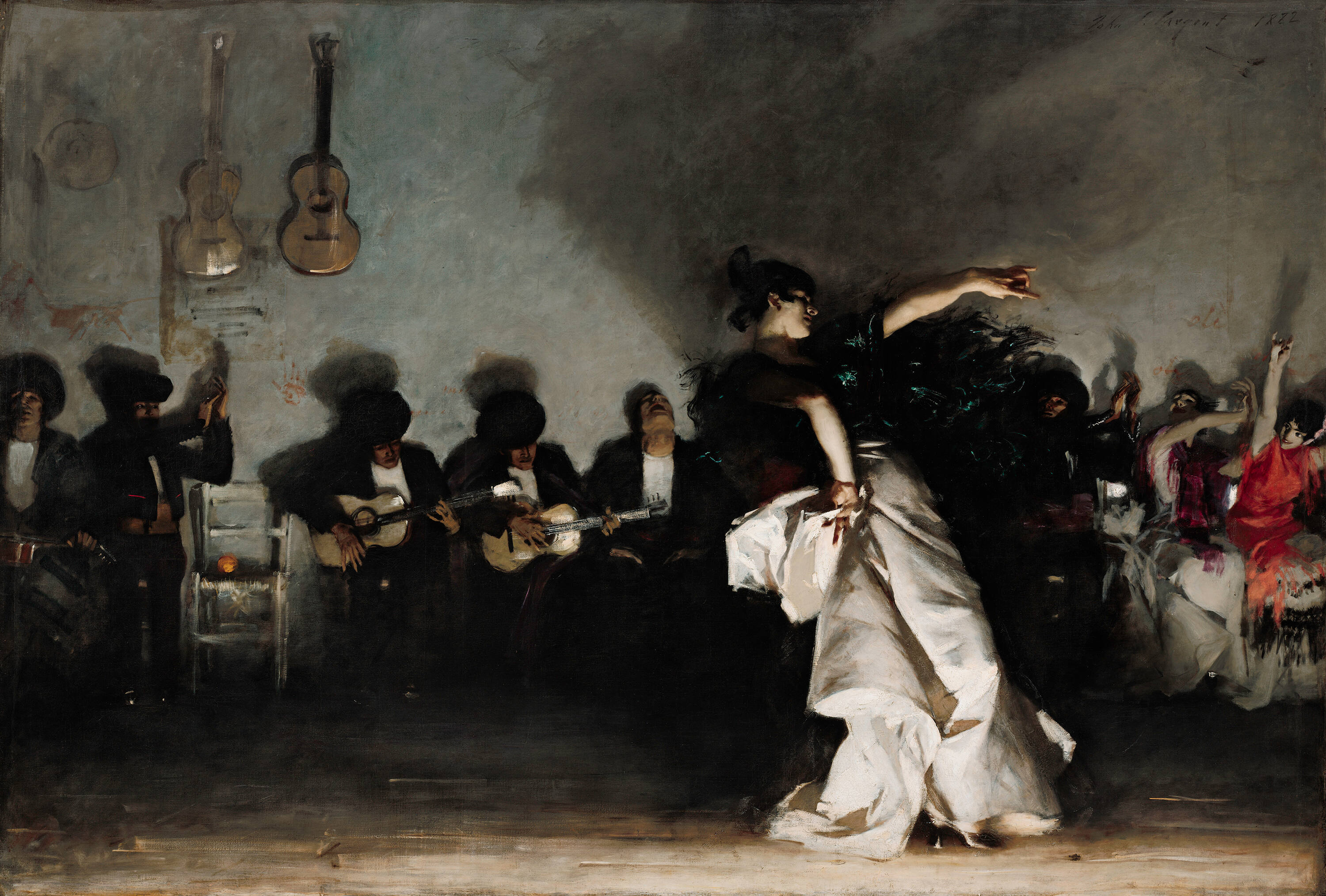
Heading image: John Singer Sargent (1856−1925), El Jaleo, 1882, Oil on canvas, 232 x 348 cm. Public Domain, via the Isabella Stewart Gardner Museum, Boston.
A Note from IAMCultureCare
Greetings from IAMCultureCare!
This February, Mako Fujimura continues his series on “Stewardship and the Artist”, reflecting on the concept of kenosis and what that means for artistic collaboration.
Collaboration means a lot for me too as a musician. There are certainly people who thrive as soloists, relishing both the spotlight and the long, lonely hours of practice that allow for such individual artistry. But I don’t envy them, and the longer I’ve been away from my formal music education the more I’ve come to value other aspects of music beyond this particular “slice of expression” (a phrase I’ve stolen from Mako’s Art Is).
Solo performance — especially in the classical music world, but I think more broadly as well — is a weird medium. An audience gathers (often) for the express purpose of hearing the soloist rather than particular musical selections. After all, when was the last time you decided to go to the symphony to hear Saint-Saëns’s Violin Concerto No. 3 rather than Joshua Bell, or buy tickets to hear “Bad Blood” rather than Taylor Swift? Would it even matter which songs get played? At the extremes of stardom, the performer becomes a secular idol for a “worshipful” audience, both in the popular idiom sense (think American Idol, someone to aspire to) and as an image of divinity. Too often, the music is a medium for success and personal apotheosis — self-divinization — rather than the musician for the music.
It wasn’t always so.
The history of music in recent centuries is one of increasing individualization. Like the solo performer, so too the solo listener — “serious” music is typically engaged in a similar mode as visual art: an inner numinous experience is the goal, encountered equally in the museum or the concert hall. And in a digital age, the trend is merely accelerated. We trade shared experiences for personal listening, live performance for digital reproduction, communal expression for algorithmic recommendation. We become consumers rather than patrons. The question of how well we’ve loved our neighbor is completely irrelevant to our search for individual aesthetic pleasure.
Of course, I’m not immune to beauty’s call. Art does offer genuine, even salvific encounters with transcendence. There is an exhilaration to putting on a record (or attending a concert), cranking up the volume and basking in the full range of joy and grief that music can express. But as much as I relish both solo listening and solo performing, the moments that stick with me are usually the communal ones: singing together (equally in the car as in the concert hall or homeless shelter); sharing a new album with a friend; playing (and dancing) to big band swing; participating in the give and take that is rehearsing with others; leading a congregation in worship.
Why this disconnect? Why do we expect (and admittedly sometimes find) transcendent encounters with beauty in the museum or the concert hall, but are more often moved to tears by a friend’s sketch or an overheard lullaby?
Well, at least in part, I think it comes down to a question of telos—ultimate purpose — and a related, unhelpful distinction between art and craft.
For most of human history, music was for something. It accompanied. And it did so in and for the community. Whether it was dance, storytelling, celebration, lament, or worship, music was the common medium through which a community expressed itself. The social fabric was woven with melodic threads. Music was a just a part of life together, a skill that anyone could learn and all would participate in; it connected people; and it was simply good fun. In other words, music wasn’t just an art; it was a craft.
As in art, true craft offers an encounter with beauty, but it does so doubly in form and function. In craft, an object’s beauty is fully realized when it performs its intended purpose, or telos. A highly decorated teapot that pours badly, dribbling onto the floor rather than spilling cleanly into a cup, makes a mockery of its apparent beauty. But when it is made with care, when its beauty of utility and form are wedded in the single vessel, it becomes an instrument for peace-making in a tea ceremony. Importantly too, the object — whether a teapot or a musical work — is not fulfilling its purpose until it is engaged with in community: a lone artist may create the work, but the tea must be shared and the music danced to for the work to be whole. An “audience of one” is still an audience.
What is the telos of music? Daniel Chua thinks it is joy. Perhaps it is. It’s probably many things, not least of all community formation. What I can say with surety, though, is that the most meaningful musical experiences I’ve had all break down distinct barriers between artist and audience, art and craft. The result is a radical freedom from the burden of self-gazing: freedom to enjoy, to make, to participate, to invite — because any transcendence that is there is meant to be shared.
I wonder if this or Mako’s essay below resonates with you. If so, we’d love to hear from you! Get in touch with us about meaningful artistic experiences you’ve been a part of or ways you are embracing kenosis this month.
Jacob Beaird, Editor
A Note from Mako Fujimura
Stewardship and the Artist, Part 2 — Kenosis: The Liturgy of Collaboration
Part 1 of “Stewardship and the Artist” series may be found in the January, 2026 issue of this newsletter.
* * *
“Let each of you look not only to his own interests, but also to the interests of others. Have this mind among yourselves, which is yours in Christ Jesus…”
(Philippians 2:4 – 5)
The space in between collaborators can be a life pulse, a sacred invisible thread pulling and stretching.
In my decades-long collaboration with Susie Ibarra, I have come to pay attention to the space in between us. Just as in quantum mechanics, there are gestures of waves and percussive particles simultaneously floating in the air. We are both exploring the silence of presence in our individual works: her music elevates stillness and pause, and my response archives them. As the brush saturated with platinum mixture drips, the resulting ‘percussion’ of drops echoes Susie’s precise and attenuated rhythm. Platinum powder, mixed with hide glue — heavy and cool to the eye — spreads across the hand-woven paper made specifically for our collaboration as the quiet beat and a swirl or her drum brush begin her performance. The material captures the waiting, and they listen, too, as a generative space in between us opens up.
The Japanese concept of ma, 間 — the interval and the space between — is not empty. It is full of potential, of tension, of grace. The ideogram is Kanji (Chinese origin): 間 signifies ‘space’, but it is made up of 門 (gate) and 日 (sun). Ma is the space in between which the light fills. Kenosis lives in the ma. It is the artist’s way of journeying into the light.
The ancient hymn in Philippians 2 is a song inviting us to inhabit Christ’s kenosis (see my recent Substack series expounding on this theme) — that profound, hospitable self-emptying, filled with light like a sliver through a tea house window. We often imagine giving as subtraction, as erosion of self, silence as weakness. But kenosis is life-giving and as powerful as presence: the pouring out that makes possible the flourishing of the other. The space we relinquish is not abandoned; it is offered. It becomes a form of hospitality.
This can be true of a collaborative pianist in a classical music setting: every gesture is attuned to the breath of another, even though the note is prescribed in the composition. Music, as in life, is a rhythm of breath and movement — yielding, attending, giving in a subtle way. A pianist might delay a single note to meet the rise of a cellist’s phrase, or soften her tone to behold a singer’s probing text. These are not acts of diminishing but of profound presence.
The power of collaboration does not come alive in transactional relationships; many forms of performance today are transactional and mechanical, especially now with algorithmic precision and autotune. True collaboration is a form of covenantal practice and presence. It requires trust in the unseen work of the other, a relinquishing of control in favor of communion. In his writing on music, Jeremy Begbie speaks of “mutual indwelling,” where distinct voices do not blur into flat homogeneity but resonate in a polyphonic dance. No one voice loses its character, yet each is transformed by the other.
This is the path a culture care artist is called to steward: not to hoard or steal the artistic vision, but to invite others into the studio of becoming. In an age of platform-building and self-branding, true collaboration is a quiet revolution. It is a refusal to dominate. It is the artist’s protest against isolation and mechanical scaling, a protest not of loud resistance but of radical hospitality.
In my own practice of Nihonga painting, I find this spirit in the layers of crushed minerals and slowly drying layers, in the generational commitment of artisans to make paper and silk and to find and pulverize the minerals I use. In the tradition of Japan lacquer, it takes ten years for the Urushi tree to grow enough to produce an ounce of sap (see chapter 3 of Art Is). Each drip must wait — must yield — to that unique sacrifice. The beauty that emerges is not from any single act of giving, but from this generational commitment. The maker’s hand learns to wait, to honor what came before, to trust what will come after.
Artists are called to be stewards of such spaces — spaces where community can be formed, where difference is not erased but cherished, where beauty is not marketed but shared.
In our Culture Care journey into the light, let us be those who listen first, who create with others in mind, who make room. Not because we have nothing to offer, but because in offering, we are made more ourselves.
Let the act of collaboration be our liturgy.
Let our painting be our life-giving poem.
Mako Fujimura
Culture Care Events & Announcements
- “Dust and Gold — Makoto Fujimura & Shozo Michikawa” Exhibition—ALIEN ART CENTRE, Taiwan, Now-August 30, 2026. Major works by Mako Fujimura are exhibited in dialogue with sculptor Shozo Michikawa in an expansive two-part exhibit — each part lasting six months — reflecting on time and impermanence. The first“Luminous Chapter” invites viewers to explore the question“How is light born?”, and to discover the potential for healing and renewal. The“Formative Chapter” (beginning in April) asks“How does force take shape?”, guiding viewers to explore the gestures behind the works and how time leaves its mark.
- Call for Art: “Rent, Turn, Follow” Exhibit at the Mezzo Gallery — February 18, 2026 Deadline. Holy Cross Lutheran Church’s (St. Louis, MO) Mezzo Gallery is accepting submissions through 2/18/26. Check out the exhibit theme and submission requirements at the link above.
- Save-the-Date:“Art Is” Author Event — Lancaster PA, May 1, 2026. The Row House and Bucknell University’s Open Discourse Coalition present an evening with Mako & Haejin Fujimura on the subject of their new book, Beauty x Justice: Creating a Life of Abundance and Courage. Additional details TBA.
- Culture Care: Reconnecting with Beauty for our Common Life 2nd edition to be published July, 2026. Mako Fujimura’s original Culture Care thesis is revised and expanded, featuring additional chapters on generative thinking and Culture Care as public theology, a new introduction, foreword by David Brooks, afterword by Mark Labberton, and fresh insights and stories of Culture Care in action from the years since the original 2017 publication. Available for pre-order now at the link above.
- IAMCultureCare is hiring — part-time Project Coordinator. This part-time contractor role will assist the Fujimura Institute Director in planning and executing a one-time event in 2026. Most work will be done remotely but applicant must be able to travel to New Jersey for work during the project dates: September 17 – 20, 2026. If this is of interest, please email jacob@internationalartsmovement.org and we will share a job description.
Do you have a news item or upcoming culture care event? Consider sharing it with us for a possible feature here in the newsletter! Email jacob@internationalartsmovement.org.
Web Links
- Latest Belonging Conversation from Mako Fujimura and Julia Hendrickson.
- Joy Clarkson finds freedom in not being an expert at everything.
- Lou Stoppard reports for The Economist on museums’ evolving strategies for art preservation during climate disasters.
- Alan Jacobs beautifully sums up what ought to be the writer’s posture, so easily forgotten.
- Jacobs also falls in love with Coventry Cathedral.
- Legendary animator Hayao Miyazaki’s early-career work on an Italo-Japanese Sherlock Holmes series, with a twist.
- Matthew Milliner learns an art history lesson from Precious Moments.
- Shakespeare was surprisingly into math.
- Jim Beitler gives the first of three Hanson lectures on fantasy and justice.
- Bruce Herman’s startling new work.
- New music rec: Armenian jazz/rock pianist and composer Tigran Hamasyan’s “Manifeste” is genre-defying but very groovy.
IAMCultureCare is a registered 501c(3) non-profit organization which relies on your support to continue our“Culture Care” work amending the soil of culture as an antidote to toxic culture wars. We welcome gifts of any size to continue these efforts. You can donate online or get in touch with us about corporate sponsorship and other giving methods! You can also support IAMCC’s work with a paid subscription to Makoto Fujimura’s Substack.
All content in this newsletter belongs to the respective creators, as noted, and is used with permission. If you would like to submit something for consideration in a future newsletter issue, you may do so by filling out this form or by emailing jacob@internationalartsmovement.org.