“The question before us is not only: ‘How do I do my work well?’, but also: ‘What, exactly, has been entrusted to me to care for?”‘That is where Culture Care begins.”
– Makoto Fujimura
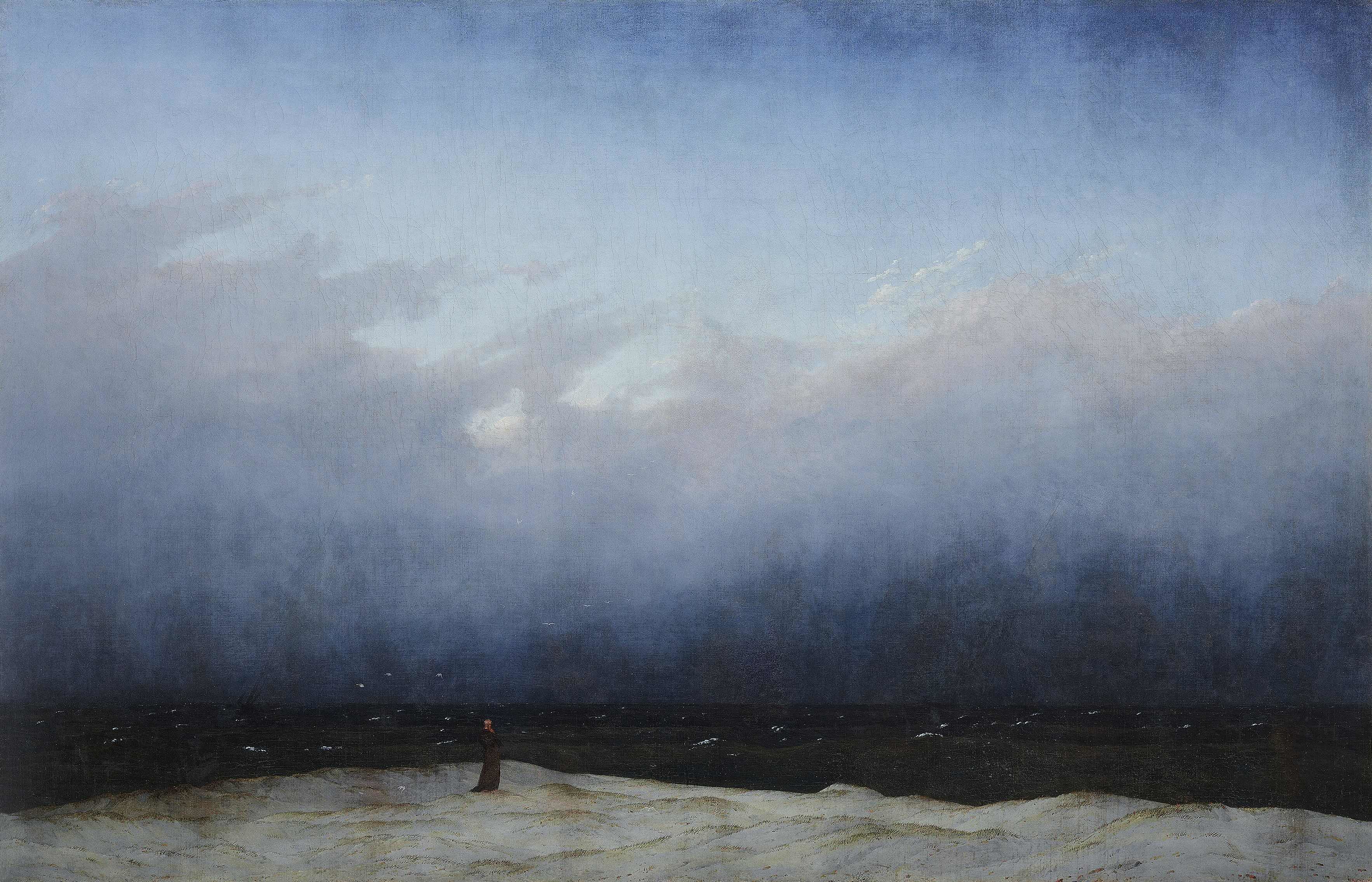
Heading image: Caspar David Friedrich (1774−1840), Mönch am Meer (“Monk by the Sea”) 1808 – 1810, oil on canvas, 110 x 171.5 cm. Public Domain, via the Staatliche Museen zu Berlin, Nationalgalerie. Photo by Andres Kilger.
A Note from IAMCultureCare
Greetings this new year!
I began writing this reflection in the air, tens of thousands of feet above Montana and halfway home from visiting my in-laws for the Christmas holiday.
I’m always staggered by the pace of air travel. For most of human history, a cross-continent journey like this would have taken months or even years of planning and a slow, dangerous journey through uncharted wilderness. There was no real surety when, or how, or even if you would get to your destination. You certainly wouldn’t arrive unchanged. Now, in just a few hours and many tons of greenhouse gases wreaking havoc on a landscape we no longer need to traverse, we can travel in relative comfort (yes, even on the cheapest economy class ticket). It’s a brutal privilege, this: convenience at the expense of beholding. If such a thing could even be measured, I’d wager that the uncomfortable, walking-pace journey of months would do much more for the health of my soul than what the destination promises to provide: quality time with much-missed relatives and friends.
Perhaps I’m aware of this now because I’ve been digesting Paul Kingsnorth’s new book Against the Machine. His claims are nothing radically new, but they amount to a sobering and intuitively compelling view of the problem at the heart of modernity, one which all our political, economic, environmental, and culture war woes seem to be merely symptoms of. Namely, we’ve largely abandoned the things which make us human. I suspect it will prove to be an important book to grapple with for those who care for culture, and I do recommend it if your New Year’s Resolution happens to involve more reading or less screen time.
One practical implication Kingsnorth offers is the setting of limits. Limits are not convenient. Indeed, sticking with them is likely to be uncomfortable: the growing pains — of putting down roots in a given place, at a given time, with given people, in acknowledgement that we have no ultimate control of our given circumstances — are real. But a limit is an opportunity for grace; and a limit embraced, paradoxically, can be freeing.
Artists know this well. It is actually the process of working within and against constraints that provides a generative environment for creativity. Whether those constraints are externally received (a handicap, limited resources or personal creative control, a terminal diagnosis) or voluntarily chosen (a medium, genre, or collaborative environment), they create a context for an artist and audience alike to participate within, communally receiving an artwork’s meaning in light of the given parameters. A sonnet might push the limits of its form to the breaking point, but even so it would not be fair to judge it by the norms of haiku or free verse. Olivier Messiaen’s haunting Quartet for the End of Time—written from the inhuman conditions of a German prisoner-of-war camp in 1940 — derives much of its mythic significance from the unusual instrumentation available to the composer from among his fellow inmates. Great art is often not the product of isolated genius but rather a response to great limitations.
As the adage goes, learn the rules before you break them. In life, as much as in art, there may well be a time to transgress, to start over, to break out of an abusive system and forge something radically new. In a culture that promotes self-actualization as the ultimate virtue though, that instinct should at least give us pause. The real transgressive act these days may rather be self-limitation. So, I encourage you to find some small way this January to embrace inconvenience. Embrace givenness. Embrace roots. From what else will life grow?
A Note from Makoto Fujimura
Stewardship and the Artist — Part 1: When Your Work Is “Not Your Own”
IAMCultureCare recently received a letter from a pianist teaching at a Christian liberal arts college. He performs with a symphony and works as a professional accompanist. His question reveals a quiet tension many artists carry. He writes:
“I feel like my artistic expression is, in a way, triply not my own. Firstly, I am not a composer, so I play others’ compositions, often vocal works shaped first by text. Secondly, I am primarily a collaborative pianist, so all of my interpretations emerge from rehearsal — a dynamic consensus with partners or ensembles. Thirdly, I rarely choose the repertoire I play, whether I’m hired for someone else’s concert or contracted by the symphony.”
In our journey toward Culture Care, how do we practice stewardship when the work itself is shaped by others — others’ compositions, others’ choices, others’ visions?
Many artists inhabit this very terrain. Performers, designers, editors, ensemble musicians, arts administrators, educators — all often create within constraints they did not choose. We’ve used the term “cultural catalysts” to describe those who facilitate or support the arts without always claiming the title of “artist.” But even within artistic practice, there is a call to become caretakers — stewards — of work we did not initiate.
This also raises a central challenge for many of us:
How do we steward our art when our agency is limited, and when the structures around us are not always conducive to flourishing? We’ll explore this question in a three-part series over the coming months.
I. The Challenge: A Culture of Limited Agency
One of the most persistent myths of modern creativity is that of the autonomous artist — the solitary genius, freely choosing the subject, medium, tempo, and direction, accountable only to their inner vision. But for most artists, the reality is quite different.
A collaborative musician is one example of this reality, but it stretches across disciplines. Many artists today:
- interpret rather than originate,
- work within institutional and inherited structures,
- create amid limitations of time, budget, and permission,
- offer their craft through dialogue, adjustment, and trust.
Their creative lives are profoundly relational.
This is not a compromise of vocation — it is a faithful rendering of it. Most artists do not begin with a blank canvas. They receive a score, a script, a commission, a syllabus, a tradition, a community. They step into a conversation already in progress. Their work arises not from pure autonomy, but from “attentive participation”.
In Art Is: A Journey into the Light, I describe this reality as one of “interdependence”, not independence. Art is always communal; it is shaped by memory, language, material, and relationships. Even the most solitary disciplines rely upon quiet ecosystems of support: teachers, caretakers, listeners, witnesses.
Yet this recognition brings tension. If we do not fully control the content or context of our work — if excellence is demanded but the environment is depleting — what does it mean to be faithful? To be a steward? How do we care for both the work and the conditions of its making?
January is a fitting time to ask these questions. It is a season of beginning, but also of honest reckoning. Many artists carry these questions implicitly:
- Am I stewarding my gifts well, even when I don’t choose how they’re used?
- Is faithfulness measured by output — or by something deeper?
- What responsibility do I bear for the systems in which I create?
In a culture that prizes autonomy, constraint can feel like diminishment. But the Christian imagination offers a different vision. Scripture presents vocation not as freedom of choice, but as a “faithful response” — a listening before speaking, a receiving before making.
The culture care path is to hold this question in tension, as that will deepen it for communal reflection.
If stewardship is our call, and interdependence is our reality, then stewardship cannot mean only managing personal talent. It must also include the care of relationships, institutions, and inherited forms that shape how that talent is offered.
So the question before us is not only: “How do I do my work well?”, but also: “What, exactly, has been entrusted to me to care for?”
That is where Culture Care begins.
In the next two essays, I hope to reflect on “Stewardship as Creative Resistance,” followed by “A Renewed Vision of Artistic Leadership.” These explorations are not answers, but invitations. We create in dialogue — with tradition, with our collaborators, with a viewer, a listener, a reader. And ultimately, we create before the “Audience of One.”
In Art Is: A Journey into the Light, I describe my resistance to the notion of “self-expression.” I believe our work is not simply for us, nor even from us. It is given, so that others might respond. The work itself seeks its beholder. Its agency exists in invitation rather than isolation.
There is a paradox at the heart of creation. The work is born of us, yet is not ours. It longs to be seen, but lives even unseen. It is dependent on polished talent, yet the gift is independent of the marketplace.
I will explore this paradox further in the coming essays. I’m also writing on “kenosis” — self-giving — in a series on my Substack (@iamfujimura). Paid subscribers there help make this newsletter production possible, and that act itself becomes generative.
Let us begin again:
With listening.
With care.
With trust in the unseen.
Mako Fujimura
Culture Care Events & Announcements
- “Art Is: A Journey into the Light” Lecture & Reception—Yale University, New Haven CT, January 25, 2026. The St. Thomas More Center at Yale University welcomes Makoto Fujimura to give the Fay Vincent, Jr. Fellowship in Faith and Culture lecture. Mako will share about the process of writing as a visual artist, drawing from his books to ask questions like, “What does it mean to be ‘called’ as an artist?” “What does it mean to create beauty today (especially in contemporary art)?” And, “What does it mean to develop a ‘sanctified imagination’?” Space is limited and (free) registration is required at the link above. The lecture will also be live-streamed.
- “Dust and Gold — Makoto Fujimura & Shozo Michikawa” Exhibition—ALIEN ART CENTRE, Taiwan, Now-August 30, 2026. Major works by Mako Fujimura are exhibited in dialogue with sculptor Shozo Michikawa in an expansive two-part exhibit — each part lasting six months — reflecting on time and impermanence. The first“Luminous Chapter” invites viewers to explore the question“How is light born?”, and to discover the potential for healing and renewal. The“Formative Chapter” (beginning in April) asks“How does force take shape?”, guiding viewers to explore the gestures behind the works and how time leaves its mark.
- Windrider Summit at Sundance — Park City UT, January 25 – 30, 2026. Join the Windrider Institute in its annual Summit at the Sundance Film Festival. The Windrider Summit is a one-of-a-kind cultural experience. It is an opportunity to attend the premiere festival for independent films and interact with a community who shares a belief in the transformative power of story. It is also a chance to bring a distinctively spiritual and theological lens to film and explore some of the most important topics in our culture. Register at the link above.
- Save-the-Date: “Art Is” Author Event — Lancaster PA, May 1, 2026. Bucknell University’s Open Discourse Coalition and The Row House present an evening with Mako Fujimura on the subject of his new book, Art Is: A Journey into the Light. Additional details TBA.
- Culture Care: Reconnecting with Beauty for our Common Life 2nd edition to be published July, 2026. Mako Fujimura’s original Culture Care thesis is revised and expanded, featuring additional chapters on generative thinking and Culture Care as public theology, a new introduction, foreword by David Brooks, afterword by Mark Labberton, and fresh insights and stories of Culture Care in action from the years since the original 2017 publication. Available for pre-order now at the link above.
Do you have a news item or upcoming culture care event? Consider sharing it with us for a possible feature here in the newsletter! Email jacob@internationalartsmovement.org.
Web Links
- Chris Wiman writes for Harper’s on consciousness, God, and our limited understanding of reality.
- A virtual tour of The MET’s Helene Schjerfbeck exhibit, whose evocative paintings are finally receiving recognition outside her native Scandinavia.
- Phil Christman considers the necessity of the college town, in The Hedgehog Review.
- Czesław Miłosz takes on the problem of evil, in a poetic defense of his cat.
- The scandalous story of Susannah Cibber, Handel’s favorite soprano.
- My music feeds this past month have been exclusively inundated by Christmas releases, so here’s a fun old music rec: French vocal Jazz scatting by Les Double Six, originally recorded in the 60s.
- Latest Belonging Conversation from Mako Fujimura and Julia Hendrickson.
- W. David O. Taylor’s 90-second book reviews.
- In a lecture for Rabbit Room, Winfield Bevins encourages churches to start art galleries.
IAMCultureCare is a registered 501c(3) non-profit organization which relies on your support to continue our“Culture Care” work amending the soil of culture as an antidote to toxic culture wars. We welcome gifts of any size to continue these efforts. You can donate online or get in touch with us about corporate sponsorship and other giving methods! You can also support IAMCC’s work with a paid subscription to Makoto Fujimura’s Substack.
All content in this newsletter belongs to the respective creators, as noted, and is used with permission. If you would like to submit something for consideration in a future newsletter issue, you may do so by filling out this form or by emailing jacob@internationalartsmovement.org.