
“Justice itself requires the imagination of abundance — the conviction that another person’s flourishing does not diminish yours. The artist who stewards her imagination faithfully is, in this sense, a justice worker. She makes space for the kind of beholding that justice requires.”
– Makoto Fujimura
Heading image: Fra Angelico (c.1395 – 1455), Mocking of Christ (Cell 7), c.1440 – 1442, fresco, 181 x 151 cm. Museum of San Marco. Public Domain, via Wikimedia Commons.
A Note from IAMCultureCare
This month, Mako concludes his series on artistic stewardship with a reflection on attention. I think he’s right that attention — on the part of the artist and the audience alike — is the essence of what it means to create and is fundamentally an act of love.
I won’t spoil Mako’s essay further, but I wanted to take time and attend myself to a remarkable artwork I came across earlier this year. It’s a fresco depicting the mocking of Christ by Fra Angelico, and appears above as this newsletter’s heading image (also downloadable here). I find it to be psychologically arresting and unlike any other depiction of the Passion I’ve seen before.
Start with the way Fra Angelico frames the work. The fresco is painted on the wall of a monk’s cell in Florence’s San Marco convent. But the archway, that on first glance appears to be a frame, is actually painted on. It’s a deliberate artistic choice that sits rather awkwardly in the space, intersecting with the curve of the ceiling on the upper left side. Angelico’s archway is a literal framing device, a window through which we see into a room with two figures in the foreground.
But there’s a second frame, isn’t there: the green rectangle in the background functions as a frame within a frame, creating an artwork within an artwork. Maybe I’m reading too much into it, but I have a hunch that there’s something more being depicted here than a single scene; that the fresco’s subject is as much the relationship between the foreground figures and the background artwork as it is the entire whole; that even, perhaps, what we are meant to contemplate here is not just a single fresco but rather the concept of artistic practice and contemplation itself. Hold that thought.
All this is instantaneous and subliminal. What we are first conscious of being drawn to is the figure of Christ, who at once transcends the fresco’s internal spatial logic just established. From the waist up, he exists neatly inside the inner frame, simply part of a painting on the wall. But below, his clothing spills out in three-dimensional reality into the solid block of marble, and as soon as we follow his gaze down to the figure of Mary, he leaves the frame and enters the room with us. Our eyes then follow Mary’s right-hand gesture toward St. Dominic (iconographically identifiable by his star and studious activity) before returning to the figure of Christ, now fully present in the space by virtue of this journey.
This triangular path is an intentional and a well-documented renaissance technique. The fresco and others like it in the convent were meant to inspire prayer and contemplation for individual monks, and in my research about this painting I kept coming across the suggestion that Mary and Dominic are respectively depicted here as examples of humble acquiescence to, and pious meditation on, the scene depicted. The single monk who lived in this cell would be daily drawn from Christ to Mary to Dominic and back again, thereby forming his imagination to their pattern of saintly contemplation.
But that’s not the only message I get from this work, because while Mary and Dominic may only be able to imaginatively contemplate the mocking of Christ in their minds’ eye, we can see it in the background, and we can see them. Notably, they turn away. Mary shields her face, unable to bear the sight of her son’s suffering. Dominic studies his scriptures but is too intent on the written word to look up and see that which he reads about.
All eyes are averted.
Except — curiously — the spitting soldier’s.
Even more curiously, though Fra Angelico gives him no body or limbs, he does paint him a hat.
This disembodied soldier looks directly into the face of Christ, and doffs his cap even as he spits. It is a mocking act, but in some sense he is also the only one in the fresco paying attention. Doffing one’s hat is a sign of respect which we think of now as ubiquitous, if a little old-fashioned, but for Fra Angelico it would have been a relatively new practice which mimicked medieval knights removing their helmets to show they came in peace. Fra Angelico’s soldier, at least on some level, recognizes that he is encountering someone worthy of honor.
I’m also struck by the dynamic activity of this spitting soldier compared to the passivity in everyone else. We see that in Mary and Dominic’s contemplation. But Christ too is serenely passive, almost as if to invite the mockery in a way that is reminiscent of Shūsako Endō’s novel Silence. I wonder whether the soldier’s spittle isn’t then a further act of attention. In a similarly shocking vein as the infamous 1974 performance art piece “Rhythm 0”, where artist Marina Abramović stood still for six hours and invited audience members to do whatever they wanted to her using seventy-two objects she placed nearby (including a rose, perfume, food, a scalpel, and a loaded gun), the spitting soldier is the only one attending to the invitation of Christ.
Many of us have recently journeyed through the Christian Holy Week, which yearly recounts the story of Christ’s suffering, death, and resurrection. And many of us, during a Palm Sunday or Good Friday service, corporately read the Passion narrative aloud, joining in with the crowd to shout “Crucify him!” and thus symbolically identifying with those who put Christ to death. For me, something similar is happening here. The posture Fra Angelico enjoins isn’t (just) the humility of St. Mary or the theological study of St. Dominic, but rather a self-identification with the mockers which Endō’s fumi‑e echo.
Of course, perhaps that spitting soldier isn’t truly paying attention any more than Mary or Dominic are. He apparently doesn’t attend enough to see Christ’s closed eyes of acceptance, to question his own act of violence toward the seated figure who retains, despite the mockery, a regal dignity. His disembodied face, shoulder-level with Jesus, cannot look anywhere but ahead, and so misses both the white robes of human innocence and the divine halo alike. He too does not see Christ for who he really is.
The overall effect is an indictment of every figure present — Fra Angelico’s Christ is seated in posture of monarchical judgment, after all. If the fresco is meant to facilitate contemplation, its own saintly exemplars fail. If to inspire action, the action depicted is one of inevitable violence. Returning to the meta level, with the fresco’s double framing suggesting art itself as a secondary subject, Fra Angelico’s own vocation is similarly in the offing. In some sense he, along with every artist, is like the spitting soldier: simultaneously seeking to show respect by attending to his source of inspiration while also knowing that in the very act of creation there will be some loss, some spitting violence — whether through lack of skill or time or human error — to that vision he originally intended to paint.
Why then does he implicate himself by painting this scene in such a radical way?
The key, again, is in the eyes.
Behind the blindfold, Christ’s eyes are closed. But this is not a nascent version of blind justice; in fact, Lady Justice was only first artistically depicted as blindfolded several decades after Fra Angelico painted this work. This is, instead, blind mercy. The blindfold is transparent. Christ is a victim with agency. He is able to open his eyes at any point to bear witness to the violence done to him by both the soldiers and the saints, but he chooses not to. Fra Angelico dares to paint his own judgement because he entrusts his creative act to those eyes of mercy.
More to the point, it’s only through Fra Angelico’s artistic faithfulness — his stewardship of attention to the fullness of discomfiting reality — that there is even an archway for us to look through. And that, friends, is worth paying attention to.
Jacob Beaird, Editor
(For more on Fra Angelico, check out Mako’s 2006 essay “Fra Angelico and the Five Hundred Year Question” here.)
A Note From Mako Fujimura, Founder of IAMCultureCare
Stewardship and the Artist, Part 3 — “Attention Must be Paid”
Parts 1 and 2 of “Stewardship and the Artist” series may be found in the January and February 2026 issues of this newsletter, respectively.
* * *
Simone Weil wrote that attention is the rarest and purest form of generosity.
Jacques Maritain, in “The Responsibility of the Artist”, named two obligations in tension within every maker: fidelity to the work itself — its inner logic, its unfolding necessity — and fidelity to the human community in which the work will appear. These are not competing loyalties: they are the two parallel paths. The stewardship of the imagination lives by attending to the liminal space between them.
The Resistance of Attention
The act of love is the ability to attend to another person without preconditions, to truly hear the other. Likewise, this listening stance also allows true attentiveness to our work. When I attend to my painting without preconceived notions, without trying to force it toward an outcome I have already decided, I am practicing a generative path of culture care.
We live in a time that measures value by utility, efficiency, and visibility — we call this the “Attention Economy”. This, our culture care path, will necessarily resist these market forces, forging another way forward. The kind of art that must justify itself by its market, its message, its platform, its reach can be soulless. And the artist, slowly, without quite noticing, begins to make work not from the vision she has been given, but from the vision she has been sold.
In our new book “Beauty and Justice”, Haejin and I argue that beauty is not decoration added to the utility of justice. It is the quality of a loving attention that makes justice possible — the capacity to behold another person in their full particular humanity. That capacity must be cultivated, practiced, protected. Which means it can also be lost. Or sold in counterfeit.
In my own practice — in the slow layering of mineral pigment, in the patient discipline that Nihonga requires — I have had to learn this slower and authentic path. The vision also asks for trust: that the particular weight of ground azurite on specific paper carries meaning that cannot be abstracted or accelerated; that it reveals the Real. The beauty of slowness is not a defect. It is an essential witness. Each prismatic pigment points to the potential of earth to invite a heavenly gaze.
To steward the imagination is to practice fidelity to the vision one has been given rather than the vision one has been sold.
This is where Culture Care lives — in this narrow passage between integrity and responsibility. The artist tends. The artist tills the soil of culture with humility, allowing the art to emerge according to its own necessity. And in doing so, the work quietly resists the deforming pressures of the surrounding culture and the market through the sheer fact of its presence — its refusal to be merely useful.
The Audience That Does Not Exist
When Haejin and I went to see Arthur Miller’s “Death of a Salesman” (see my Substack “review”) — now in its sixth Broadway revival under Joe Mantello’s direction — we found, unexpectedly, a parable about this implicit failure of seeking attention in sheer market terms. Willy Loman is a portrait of an artist who has confused his audience. He has spent his life performing for an audience that does not exist — a composite of his own longing, his father’s absence, his brother’s mythologized success. He has never made anything for an Audience of One.
Nathan Lane fills the stage with all of Willy’s accumulation — and lets us see the hollow at its center. When he says, “I’m very well liked in Hartford,” the line lands as both boast and prayer. It is the sound of a man selling to a customer who has already left. Willy made himself in response to a cultural script. And it was not enough. It was never going to be enough.
Laurie Metcalf’s Linda watches all of this from within the wreckage. Her speech — “Attention must be paid” — lands not as a reproach but as an elegy. She is not asking us to admire Willy. She is asking us to witness and behold him. The steward-artist holds that same discipline: she does not flatter the culture, and she does not condemn it. She witnesses it, holding the particular without abstraction, the broken without false resolution.
The Gift Economy of Art
Artistic leadership rarely resembles authority. More often it appears as hospitality. As I’ve noted in my “review”, Caroline Shaw’s original score for the production — spare, searching, at times almost inaudible — is an example. She does not score the emotions the audience expects. She scores the silence beneath them. She serves the play without serving herself to it. That restraint is kenotic: the refusal to fill what should remain open.
When I speak of the Audience of One, I am suggesting that orientation toward God is what frees the artist from the pressures that most distort the work. When the artist works before God, the work becomes an offering rather than self-expression. And paradoxically, that offering becomes more hospitable, not less. It is released without coercion, entering the world with open hands.
In “Culture Care” I wrote about moving from consumption toward commonwealth, from scarcity toward abundance. “Beauty and Justice” presses further (and expands the “G’s” of generative life to five from three): justice itself requires the imagination of abundance — the conviction that another person’s flourishing does not diminish yours. The artist who stewards her imagination faithfully is, in this sense, a justice worker. She makes space for the kind of beholding that justice requires.
Maritain observed that once made, the work possesses a kind of relative autonomy — it enters the world and speaks beyond the maker’s intention, saying things the artist did not know she had said, meeting needs she could not have anticipated. Stewardship, then, is not ownership. It is participation in a gift economy. The work emerges through grace, and then it is given away.
The artist who practices stewardship must mourn what the dream has cost. And then offer, from that mourning, not an escape, but a different imagination of what a life might be for. To keep making. To keep tending. To keep offering — even when the work is no longer entirely our own.
Attention must be paid.
Yes. And it must be paid with love.
Death of a Salesman is playing at the Winter Garden Theatre, 1634 Broadway, New York City. Previews began March 6, 2026; opening night is April 9, 2026. The production runs through August 9, 2026. Directed by Joe Mantello. Starring Nathan Lane, Laurie Metcalf, and Christopher Abbott. Original score by Caroline Shaw.
Timothy Jones: The Stars that Started My Questions
Have you ever taken a trip that held an unexpected encounter? I thought it would be a mundane excursion one Saturday morning when my mom, my dad, Kevin, and I piled into our Chevrolet station wagon. We left behind the cars and smog — the stale emissions and haze hanging over our southern California suburb. We drove toward a semirural setting a couple of hours out, hoping for some quiet, some escape.
I don’t remember everything we did during our one-day outing — a stop at a California town with quaint bakeries, maybe a fudge shop with sugary smells. On the return trip home, I stretched out in the back compartment. This was before you had to wear seat belts, and the rear of a wagon could be your personal nap space.
I could see, through the sloping back window, the night sky. Not just any glimpse, though. The glow of city lights had always dimmed the stars back home, turning the sky into a giant gray napkin with flecks of dulled glitter.
But now, in a canopy washed clean of pollutants, I saw the Milky Way. In the dark backcountry, I could see the stars spattered in a vivid, twinkling band. Pinpoints but also a scintillating glimpse of a lit hugeness above.
It was awe at first sight.
I didn’t have the words then to understand everything I was sensing. But I held the experience close. And in this glimpse, in a scene so panoramic, the effect so dramatic, I felt an awakening to wonder. There was an abundance here, even in the range of sight of a child.
“After the one extravagant gesture of creation,” writes poet and essayist Annie Dillard, “the universe has continued to deal in extravagances.” For don’t we see creativity interwoven and braided into the very fabric of the universe? An ongoing magnificence?
A child sees a parent making something — kneading yeasty bread, shaping the legs of a chair in a workshop, creating music on a keyboard, or, with my dad, fashioning jewelry from turquoise and silver — and gets a clue about a larger person fashioning what comes about. “God created,” wrote Makoto Fujimura in Art and Faith, “because it is in God’s nature to make and create…God created out of abundance and exuberance, and the universe (and we) exist because God loves to create.”
And something happens in the old creation account many of us know, something I’m only now noticing. You could make a case that at the beginning of the world in the Hebrew Bible, when God speaks, “Let there be …” it is light that appears as the first created thing. Light served to illumine our lives and keep us from the worrying dark. Land and water, plants and animals — yes. But the showing forth of light itself had to happen first. Stars and planets had to be made.
In his universe-making, the divine moves on to flinging bright into the inky night. And it was night-sky light that so impressed itself on me. The ancients knew that light would rescue us when we glimpse the dawn after a restless dark night with bad dreams. Rouse our sleepy awareness.
For light makes you alert. Illumination guides, the way a candle or a light switch in a dark room leaves your eyes adjusting for a moment, but at least you don’t bark your shins on furniture as you walk to the kitchen for water. Light refracts off layers of paint in ways that suggest barely seen depths.
In a universe that can look grim, knowing this makes all the difference. Seemingly impenetrable darkness becomes a backdrop for astonishment, illumination. In time, as I grew, I began to notice how moments of the breathtaking — and the heartbreaking as well — gesture beyond themselves. A glimpse out the car window, a scene half noticed in passing, even a sleepless night can catch the eye and stir us, as if the ordinary world were gently pointing past itself. Not that I saw all this that starry night. But I would eventually.
Later, when Jill, now my wife, and I fell for each other, I learned how a loved one’s face bathed in the flickering light from a fireplace can reorient me. Even glimpses stolen from a hectic day put me back in touch. Reconnect me. I try to sit still when noticing the wonder, knowing, as Flannery O’Connor said, that sunlight can make the meanest (commonest) tree shine in radiant glory.
When I teach and write, I often make the point that lifting our eyes from our screens and looking out a window can not only spur creativity, it can also become a spiritual practice. There’s so much to notice!
And only just now do I realize how that practice traces further back in my life than I realized. There’s more going on outside even a car window than we often realize. More to see than maybe we ever suspected.
Timothy Jones is a pastor and author known for helping people uncover greater warmth and depth in their relationship with God. His writing may be found at his blog, Substack, and in his new book Fully Beloved: Meeting God in Our Heartaches and Our Hopes.
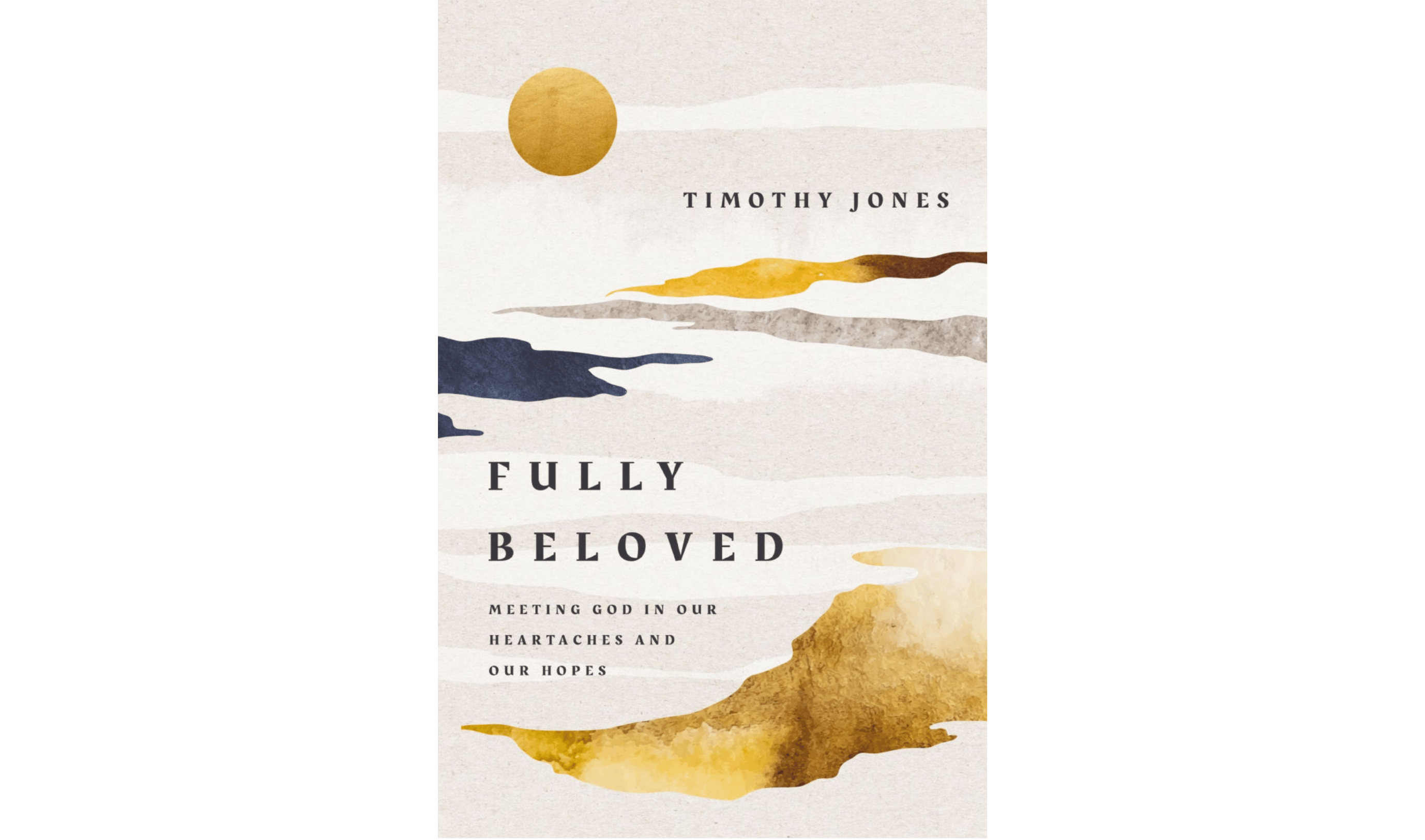
The above essay is adapted from FULLY BELOVED, copyright © 2026 by Timothy Jones, published by Thomas Nelson. Available wherever books are sold.
Culture Care Events & Announcements
- “Dust and Gold — Makoto Fujimura & Shozo Michikawa” Exhibition—ALIEN ART CENTRE, Taiwan, Now-August 30, 2026. Major works by Mako Fujimura are exhibited in dialogue with sculptor Shozo Michikawa in an expansive two-part exhibit — each part lasting six months — reflecting on time and impermanence. The first“Luminous Chapter” invited viewers to explore the question“How is light born?”, and to discover the potential for healing and renewal. The“Formative Chapter” (beginning this month!) asks“How does force take shape?”, guiding viewers to explore the gestures behind the works and how time leaves its mark.
- Beauty x Justice: Creating a Life of Abundance and Courage Available Now. Makoto & Haejin Fujimura’s co-authored book on the relationship between beauty and justice is out now and available wherever good books are sold. Through stories from their global work in the arts, advocacy, and cultural renewal, the authors reveal that beauty isn’t a luxury — it’s essential to effective, lasting justice work. Beauty has the power to heal, and justice becomes most compelling when it is truly beautiful.
- Makoto Fujimura Exhibit—Tokyo Japan, Now-April 20. Work by Mako Fujimura is exhibited at Sukiwa Gallery in Tokyo.
- “Beauty and Justice” Author Event—Tokyo Japan, April 17, 2026 @7:30PM JST. Community Arts Tokyo presents an evening with Mako & Haejin Fujimura to discuss the themes of their new book.
- “Art & Faith” Author Event — Tokyo Japan, April 19, 2026 @9:45AM JST. Tokyo Union Church presents an author talk from Mako Fujimura on his book Art+Faith: A Theology of Making.
- “Beauty and Justice” Lecture—Hong Kong, April 24, 2026 @7:00PM. Mako and Haejin Fujimura will give The University of Hong Kong’s Faith and Global Engagement Public Lecture on the theme of their new book. Free registration required at the link above.
- SOLD OUT “Beauty and Justice” Author Event — Lancaster PA, May 1, 2026. The Row House and Bucknell University’s Open Discourse Coalition present an evening with Mako & Haejin Fujimura on the subject of their new book, Beauty x Justice: Creating a Life of Abundance and Courage. Sign up for the waitlist at the link above.
- Trinity Forum Online Conversation—May 15, 2026 @1:30PM ET. Trinity Forum hosts a conversation between Mako and Haejin Fujimura about their new book.
- Culture Care: Reconnecting with Beauty for our Common Life 2nd edition to be published July, 2026. Mako Fujimura’s original Culture Care thesis is revised and expanded, featuring additional chapters on generative thinking and Culture Care as public theology, a new introduction, foreword by David Brooks, afterword by Mark Labberton, and fresh insights and stories of Culture Care in action from the years since the original 2017 publication. Available for pre-order now at the link above.
- RENEW 2026: Courageous Creativity—Washington DC, Sept 2 – 4. Mako Fujimura will give a keynote lecture at Dream Collective’s annual conference, a “two day gathering for pastors, creatives, entrepreneurs, and thought leaders allowing their faith to take visible form through beauty, leadership, and action. This year, we will explore Courageous Creativity: what does it take to cultivate a bold faith that shapes culture?”
Do you have a news item or upcoming culture care event? Consider sharing it with us for a possible feature here in the newsletter! Email jacob@internationalartsmovement.org.
Web Links
- Latest Belonging Conversation from Mako Fujimura and Julia Hendrickson.
- Artist and former IAM staff Joyce Yu-Jean Lee transforms a NYC subway station into an “oceanic cathedral”. Mako and Clayton Fujimura visit.
- Michael Schindler considers childhood attachment and the nature of divine love, vis-a-vis Winnie-the-Pooh.
- Artist Josh Kline critiques the New York City art scene, suggesting that the future of American contemporary art will be found elsewhere.
- John-Paul Stonard on the art of John Constable.
- Jen Pollock Michel on art and the slow growth of wisdom, for Inkwell.
- Christina Brown writes liturgies for the death of seeds.
- The identity of Banksy has been (possibly) revealed. Not that it changes much about the artist’s mystique.
- Implicit in Alan Jacob’s compelling account for The Hedgehog Review, a culture care-posture of beholding is the only path toward a beneficial humanism.
- Mako Fujimura interviews artist Carmelle Beaugelin Caldwell.
- New music rec: in “Dialogos”, Canadian ensemble Constantinople joins Holland Baroque to imagine the meeting between St. Francis and Sultan Malik Al-Kamil in the midst of war.
IAMCultureCare is a registered 501c(3) non-profit organization which relies on your support to continue our“Culture Care” work amending the soil of culture as an antidote to toxic culture wars. We welcome gifts of any size to continue these efforts. You can donate online or get in touch with us about corporate sponsorship and other giving methods! You can also support IAMCC’s work with a paid subscription to Makoto Fujimura’s Substack.
All content in this newsletter belongs to the respective creators, as noted, and is used with permission. If you would like to submit something for consideration in a future newsletter issue, you may do so by filling out this form or by emailing jacob@internationalartsmovement.org.