“A book, like my paintings, is not finished when the last layer dries.”
– Makoto Fujimura
A Note from Makoto Fujimura, Founder of IAMCultureCare
Dear Friends of Culture Care,
As you may notice, we will be introducing a simpler newsletter format over the coming months. We want to thank Jacob Beaird for being a great essayist and editor for the past few years. He will be stepping back from his formal role at IAMCultureCare to begin his graduate studies.
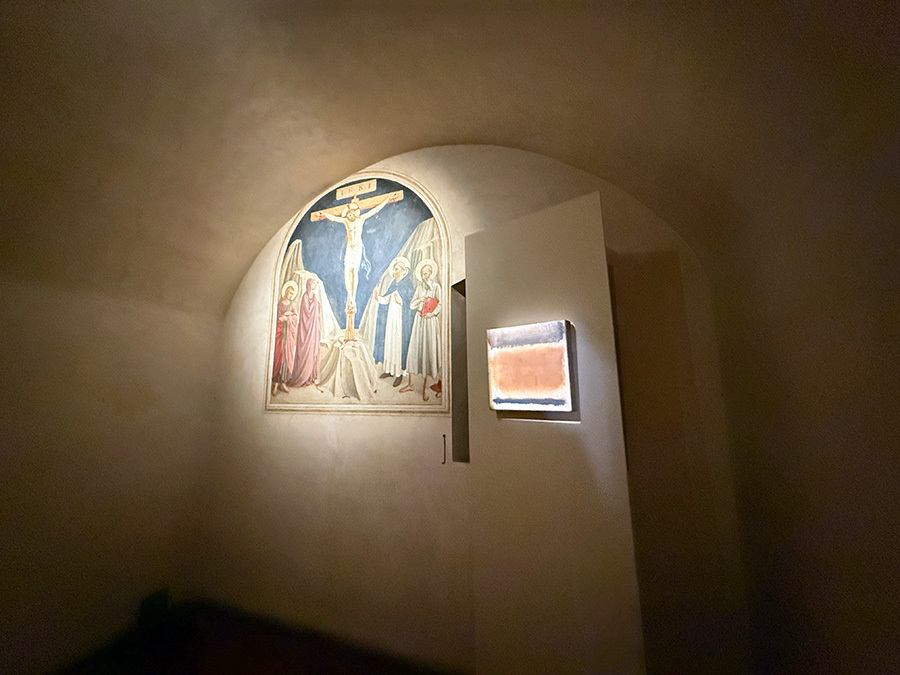
In the meantime, I will be writing about my recent trips, including San Marco monastery in Florence (previewed in the heading photo above), coming up in future newsletters.
Culture Care is released by IVPress in its second edition this summer, nine years after its first printing, and as our nation marks 250 years of contested, unfinished becoming. See my recent essay on “Behold the Cracks” further on my culture care thoughts for America’s moment. When I began to articulate culture care many years ago, I posited that we are called to be generative rather than merely reactive, to tend the soil of culture as gardeners rather than treat it as a battlefield. I did not know then how urgently that argument would need to be renewed fifteen years later.
We have spent the years since in deepening fractures — political, technological, spiritual — and I have watched the gift-economy thesis at the heart of this book tested against real fires, real griefs, real fractures in real communities. This new edition carries fresh chapters on generative thinking and on Culture Care as public theology, but more than the added material, what moves me is the company the book now keeps: a foreword by David Brooks, an afterword by Mark Labberton, and — deeply precious to me — the stories that have come back over these years from readers who took the thesis and planted it themselves, in classrooms and city blocks and studios I will never visit.
A book, like my paintings, is not finished when the last layer dries; it is finished when it is received, held up to the light, and allowed to keep refracting. That the light is being tended in so many unseen places, is itself the answer to the question the book has always asked: what has been entrusted to you to care for?
Consider starting a Culture Care group in your area. There is a Reader’s Guide in the back of the Culture Care book to make it easier for you to start a group in your community or a church.
With gratitude,
Makoto Fujimura
A Note of Thanks, From the Editor
Dear Friends,
This month’s missive is more personal in nature. As Mako mentions above, I am beginning a Master of Divinity degree at Westminster Seminary in Philadelphia this fall, and will be closing out my formal editorial role with IAMCultureCare this month. It has been a personal joy and honor to serve IAMCC these past three years. Thank you for reading, for welcoming me to this community, and for your thoughtful conversations. I hope to continue contributing to IAM and the broader culture care movement in various ways going forward, including occasional contributions to this newsletter and perhaps via Substack.
In the web links below I’ve included a piece by John Ahern on the virtues of the meandering essay. It rings true to me now as I consider my role. The act of writing is more than a form of efficient information transfer, an expression of a salient idea into just the right amount of words and not one more. It can also capture the author’s journey of discovery, and in reading the meandering essays of generations before the digital delete button we gain insight both into what the author thought and how he or she arrived there. (By the way, one thing I dislike so about current AI writing is that it often misses the good qualities of both the tightly edited and the meandering essay structure: it’s tediously verbose while also not going anywhere surprising, despite its length.) Such writing — such painting, such music, dance, or architecture — which avoids optimization, which hints at but doesn’t tell, which begins with one question and answers a different one is an artful resistance in a world of inhumane efficiency.
Writing is also one of the few ways (the only way?) we can radically break free of our earthly constraints of time and space — all in order to commune with another immortal soul. That’s a staggering, Promethean gift. As I reflect back on three years editing and writing for this newsletter, I am profoundly grateful for your attention and trust which have given me space to explore this world we journey through. I hope this newsletter has offered a similar, mutual encouragement in return. If you want to stay in contact, I would too! Reply to this email by the end of August or connect with me on Substack.
Finally, I know we’ve been communicating with a few of you about sharing your work on the newsletter in the future, and others have recently reached out. Our team will review outstanding submissions in the coming months and be in touch.
Jacob Beaird, Editor
Daniel Nayeri Interview Part 2
Mako and Daniel discuss Daniel’s award-winning book(s) through a Culture Care lens, and reminisce about “Friday Frydays” in New York City. The first part of the interview appears in the July 2026 newsletter.
Having trouble playing the video? Click or copy and paste the following url into your browser: https://www.youtube.com/watch?v=dp6bVvNuPfY
Culture Care Events & Announcements
RECENT & UPCOMING
- Art Is: A Journey into the Light selected as an AIGA “50 Books | 50 Covers” cover award winner — the “Academy Award” of book design! More announcements to come of this beautiful book designed by Dustin Kilgore for Yale University Press.
- LAST CHANCE: “Dust and Gold — Makoto Fujimura & Shozo Michikawa” Exhibition—ALIEN ART CENTRE, Taiwan, Now-August 30, 2026. Mako is grateful for Artrue International and ALIEN Art Centre for this remarkable year-long exhibit.
- Beauty x Justice: Creating a Life of Abundance and Courage. Mako and Haejin’s co-authored book is now available wherever books are sold. Here’s a Trinity Forum interview of the book. Byron Borger of Hearts & Mind bookstore also recently wrote: “Beauty and Justice has just catapulted to one of the most important books in this genre in our lifetime.”
- TALER & TALAR Conference—Germany, Sept 2 – 4. Mako and Haejin Fujimura will both speak at this upcoming conference held at the historic Kloster Volkenroda in Thuringia, Germany.
- RENEW 2026: Courageous Creativity — Washington, DC, Sept 24 – 25. Mako and Haejin Fujimura will be speaking at Dream Collective’s annual conference.
Check out our affiliate activities:
- Call to Gather movement started by Esther Mun, a designer extraordinaire who not only designs well known packages but culture care experiences world wide.
- Aria Swarr, a wonderful filmmaker who filmed Mako in Israel, has joined Mwendo, an award-winning film production agency in Washington D.C. They are seeking new clients and collaborations, so reach out if you have a great story to discuss to aria@mwendo.com
Web Links
- Latest Belonging Conversation from Mako Fujimura and Julia Hendrickson, asking “What if?” questions for culture care.
- Praxis’s Andy Crouch on redemptive AI.
- John Ahern calls for less editing and more meandering in essays.
- Comment highlights the friendships of Christian humanists which changed the world.
- A fun game from the MET Museum! Try and identify when and where an object comes from.
- Michael Preedy writes for The Metropolitan Review on Gore Vidal’s United States.
- Esther Berry defends drudgery.
- Taylor Worley is looking for visual artists to complete a short survey as part of a study to learn more about how artists engage with and navigate seasons of “wilderness.”
IAMCultureCare is a registered 501c(3) non-profit organization which relies on your support to continue our“Culture Care” work amending the soil of culture as an antidote to toxic culture wars. We welcome gifts of any size to continue these efforts. You can donate online or get in touch with us about corporate sponsorship and other giving methods! You can also support IAMCC’s work with a paid subscription to Makoto Fujimura’s Substack.
All content in this newsletter belongs to the respective creators, as noted, and is used with permission.