Culture Care and America 250
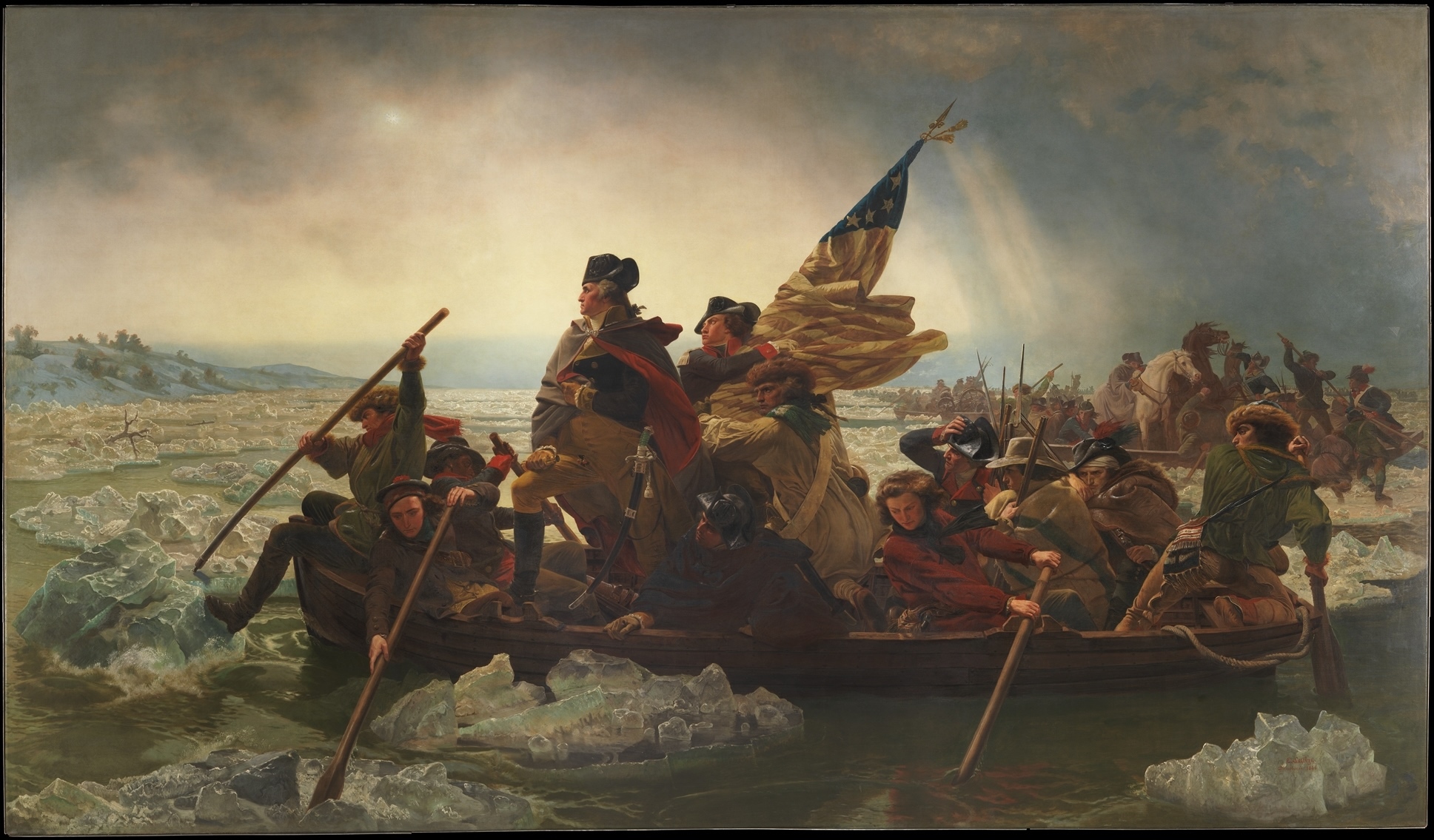
Heading image: Emanuel Leutze (American Schwäbisch Gmünd 1816 – 1868), Washington Crossing the Delaware, 1851, oil on canvas, 149 x 255 in. Public domain, via the Metropolitan Museum of Art.
A Note from IAMCultureCare
July greetings to you all from IAMCultureCare!
This month we’ve been thinking about the cultural legacy of 250 years of American history in light of the semiquincentennial (try saying that three times fast!), considering not just where America has been but also where it is going: what might the next 250 years look like?
Our newsletter heading image this month is, perhaps, the most famous piece of Revolution-era iconography. Ironically, Washington Crossing the Delaware was painted three quarters of a century years after the fact, and most of the details aren’t historically accurate. Mako Fujimura argues that may have been the point: Emanuel Leutze’s 1851 work depicts not the America that was but rather the America that Leutze dreamed of. Similarly, while our Culture Care movement is a global one, those of us who hail from these star-spangled shores have a responsibility to reckon with and understand ourselves and our past in order to better imagine a generative future.
250 years ago, America was little more than a backwater colony, a periphery in a global struggle for power between historic empires much older then than America is now. A conflict ostensibly over taxes happened to reach a bursting point at the height of the enlightenment, endowing the everyday particulars of an age-old story with ideals that transcended and universalized the politico-economic moment. America’s founding became more than a fight over livelihoods: it was a revolution of ideas with mythic (in both senses of the word) significance — ideas which belied a more complicated reality of competing economic interests, moral contradictions, and rank hypocrisy. It was a revolution won with ink, not blood, but 250 years on, it has taken much blood and sacrifice to try and prove those ideals true: a task that each generation must seemingly reenact for itself.
I’ve been thinking about our founding while slogging my way through Herman Melville’s Moby Dick—woefully behind in the reading plan I was supposed to be following — in light of a post Christina Bieber Lake wrote a few months ago about American hubris as a major theme in the novel. We Americans have such certainty, such confidence in our personal and national manifest destiny. It’s a cultural optimism that has catalyzed great things. There’s a fine line, though, between self-confidence and self-delusion; time will tell whether this flaw is fatal.
Melville’s novel is concerned with this too. From the outset, the novel seeks to catalogue the vastness of The Whale — the titular antagonist and the whaling industry, sure, but also the whale as representative of something Beyond, something Other — a task that by definition far exceeds the capacity of sailor, author, or reader alike. When faced with the vast incomprehensibility of the universe, particularly inflicted on his person by the bite of the white whale, Captain Ahab is driven mad in his monomaniacal attempt to reassert control. Melville, though, has an authorial self-awareness that Ahab lacks, and the novel’s much-maligned chapters on the specifics of nineteenth-century whaling satirize, I think, an often humorous depiction of knowledge as an almost Nietzschean will-to-power.
But compare Ahab’s will with the character of Ishmael: the most famous opening line that isn’t actually an opening line — “Call me Ishmael” — is a statement of ambiguous self-identity. I think it can be read two ways, perhaps both at once. On the one hand, it’s an obvious call-back to his biblical namesake; Ishmael is loose on the watery expanse of the world and identifies himself with a rugged forlornness that’s very American, a self-made man against nature. On the other, Ishmael is the lone survivor of an epic ruin. He’s beheld the depths of human will and is changed by a run in with something much larger than himself — Ahab, the whale, the sea, and ultimately the great Other of Reality/God. He asks, “Who am I?”, and the narrative conceit of an autobiographical voice is his attempt to give an uncertain answer.
We too must give an answer. More and more, I’m convinced that community is the alternative to the will-to-power impulse. Another thread running through the novel is the curious friendship between Ishmael and Queequeg that stands in stark contrast to the distance with which the ship’s crew view Ahab. Friendship — community — only happens with the sort of mutual vulnerability and humility so beautifully on display in the novel. There is a de-centering that must take place in order to befriend and attend to another person, a (sacramental?) mirror for how we might approach the great Other, too.
I don’t think people like Paul Kingsnorth or Wendell Berry get everything right, but they do recognize that on a basic level we need roots to thrive, to make sense of who we are, and that these cultural roots are ultimately formed in community. I find Kingsnorth’s paradigm of the “four P’s” — past, people, place, and prayer — compelling in naming those things which shape a flourishing culture. Notably, they are all physical, embodied realities; one cannot truly connect with a virtual or digital version of any of these. In pursuing them though, we must navigate the traps of both naive nostalgia on the one hand and the myth of moral progress on the other: our desires and temptations, hopes and fears, capacities for nobility and moral failing are no different now than they were in 1776. In the scale of eons, the scale of atoms and universes, of “1000 years is like a day”, America’s history is a blip in the record.
I’m starting an MDiv this fall, embarking on a seeming contradiction: theology — the study of God — asserts that finite creatures might in some way grasp an infinite God. That’s a perilous venture. Those that enter seeking knowledge as will-to-power are confronted with their own finitude and despair: the seminarian-to-atheist pipeline is real. The alternative though, as James K.A. Smith is now discovering in contemporary art and the Christian mystics, is facing finitude and rejoicing. The entry point for this is not knowing in order to control but loving in order to know: rather than naming, being named; rather than knowing, being known. There is a glorious, infinite freedom in embracing this mystery. C.S. Lewis’s (self-professed favorite) work Till We have Faces comes to mind.
Paradoxically, our culture care endeavor is a humanist enterprise only if it embraces this mystery too, understanding that we humans are not the subject of our own story. I think Melville, through Ishmael, grasps that truth. Ahab does not. This is a declaration of dependance, and in a globalized, increasingly rootless culture, it may be just what we need for the next 250 years.
Do you have any reflections on a culture care vision for our next quarter millennium? What sort of people and culture might we become? Write in and keep up the conversation!
Jacob Beaird, Editor
A Note From Makoto Fujimura
Rebuilding the Wall: Artists as Cultural Stewards
In the first essay of this series, I read Pope Leo XIV’s Magnifica Humanitas through the lens of the Theology of Making, focusing on what the machine cannot quite layer yet, what the encyclical rightly names as the irreplaceable grandeur of human creativity. Now I want to turn to the other half of the Pope’s foundational image: Babel vs. Nehemiah.
The story of Nehemiah rebuilding Jerusalem’s walls is, on its surface, a story of administration and labor. Nehemiah surveys the ruins quietly, by night, before speaking. He carefully and prayerfully distributes the work. Each family receives a section of wall adjacent to their own household — Eliashib the high priest rebuilds the Sheep Gate; the men of Jericho work beside him; the goldsmiths and merchants take their section. The wall rises not from a master plan but from thousands of proximate acts of faithful menders.
Leo XIV reads this as the template for how humanity should approach the digital revolution: not with a single architecture, imposed from above, but with distributed, participatory, subsidiarity-governed stewardship. I find this deeply resonant and I want to press into what it means specifically for artists and cultural workers, who in this moment carry a responsibility that is not yet being named clearly enough.
The Artist as Steward of the Cultural Commons
Culture Care begins with a simple but an extravagant claim: culture is not merely an expression of what we value; it is the medium through which values are formed, sustained, and — when necessary — renewed. This means that artists are not decorators of civilization. They are, in a real sense, its builders and its tenders. The Nihonga master who passes techniques to the next generation is performing an act of cultural stewardship as significant as any powerful civic institution. Perhaps more significant, because it operates for the cultivation of imagination — the foundation of what makes transformation possible.
Leo XIV’s encyclical, in its discussion of the “civilization of love,” invokes Paul VI’s vision of a society animated not by the culture of power but by the logic of gift and solidarity. The civilization of love is not a political program. It is a cultural formation. And cultural formations require makers — people who, through their practices of making, model a different way of inhabiting time, attention, and relationship than the technocratic and always scaling paradigm leaves behind.
When I work with pulverized azurite on Kumohada, I am working inside a tradition that has survived dictatorial shogunate, the Meiji abolition of the Tokugawa system, the devastation of the Second World War, and the subsequent westernization of Japanese art education. Nihonga endured because enough makers and advocates refused to let it die — not out of nostalgia, but out of a conviction that what these materials and methods carry cannot be replaced by faster or cheaper alternatives. That conviction is a Culture Care conviction. It is, in the language of Magnifica Humanitas, a form of solidarity across time. Such somatic knowledge is not scalable. But it can be generative.
Subsidiarity and the Local Practice of Making
One of the most significant principles Leo XIV reactivates in this encyclical is subsidiarity — the insistence that decisions and responsibilities should be handled at the most local level capable of handling them, and that higher-order institutions exist to support, not supplant, this local capacity. If we extend this principle further, it is to give agency to the “least of these”, of releasing power to the marginalized, and caring for our culture by sharing.
Translated into the language of culture: the creative practice of the individual studio, the local arts community, the regional cultural institution are not preliminary stages on the way to a global platform. They are the proper units of cultural formation, but they must be released to the discarded remains of our industrial scaling. The encyclical directly applies subsidiarity to the governance of AI: algorithms, platforms, and data systems must be made accountable to the communities they affect with proper management of energy discarded at the cost of the environment, and not imposed upon (particularly) the vulnerable, humans and the environment by private actors with no democratic accountability.
This is a radical claim, and I do not think its full implications have been absorbed yet. What Leo XIV is saying is that an AI system trained on the output of human culture without the consent, participation, or compensation of all the makers of that culture, including those in the “slums” of cultures, is not merely an economic injustice. It is a violation of subsidiarity. It is the appropriation of the local by the global, of the particular by the homogenizing force of scale.
For artists working in traditional forms — Nihonga, calligraphy, hand-loom weaving, oral poetic traditions — this is immediately legible. The threat is not that AI will produce things that look like our work. The threat is that it will produce them at a scale and speed that makes the slow, costly, materially grounded practice of actual human making into mounting scraps of digital remains. And when making seems too slow and costly, inefficient and irrelevant, the culture loses the very generative practices through which human dignity is enacted and renewed.
A Theology of Limits
Leo XIV writes that building for the common good means “accepting the limits and weakness of humanity without considering them an error to be corrected.” This is, unexpectedly, one of the most profound aesthetic claims in the document and it resonates deeply with the Japanese sensibility of wabi: the pathos and poverty of things, the tender awareness of impermanence and finitude that Japanese aesthetics has long cultivated as a condition of genuine beauty.
The transhumanist and posthumanist ideologies the encyclical critiques share a single root: the conviction that limit is deficiency. That aging is a disease. That death is an engineering problem. That human emotional instability, slowness, and particularity are bugs to be patched. A Theology of Making says something different: that the limit is the form. Finitude is not the obstacle to meaning but is its very condition.
When Urushi masters apply Kintsugi mending of broken pottery with gold, we do not pretend the break did not happen. It makes the break visible, permanent, and beautiful. This is a theological claim: that the wound, healed, becomes testimony. That the broken thing, rejoined, is more whole than the unbroken thing was, because now it carries the history of its fracture.
(In Maximus the Confessor’s language, we might say that the logoi of things — their shaping reasons, their participation in the divine Word — include their finitude, their particularity, their movement through time. To engineer around limits is to sever things from their logoi. It is to break their inner form in the name of improving their outer performance.)
What We Are Asked to Build
Near the conclusion of Magnifica Humanitas, Leo XIV speaks of the “construction site of our time.” He calls every person — whether scientist, artist, educator, laborer, legislator — to take up their section of the wall, as in Nehemiah. No one’s contribution is so small that it does not matter, and no one’s section of wall is so remote that its collapse will not eventually compromise the integrity of the whole.
For those of us working in the Culture Care movement, the section of wall we have been given is not a small one. We are called to tend the practices of human making — in studios, in classrooms, in communities, in the slow transmission of craft from one generation to the next — at precisely the moment when those practices are most threatened by the speed and scale of AI-mediated production. We are called to articulate why the slowness matters, why the mineral matters, why the particular hand and the particular grief and the particular joy of the particular maker cannot be optimized away without loss.
But we are also called, I think, to something more. The encyclical’s deepest claim is that the civilization of love is not a utopia but a real possibility — that it is already breaking through, wherever human beings choose solidarity over domination, communion over uniformity, gift over transaction. The studio is one of the places where this breaking-through happens. Not because art is inherently political, but because making, done with integrity, is inherently relational and based on love. It is addressed. It is offered. It opens toward the other. In Theseus’s words in Shakespeare’s A Midsummer Night’s Dream, it gives each subsidiary and particularity a “local habitation and a name”.
My Nihonga work has always been, in some sense, a love letter to the masters who formed me, to the Nagasaki and 9⁄11 victims whose deaths hover in the ground of my Hours and Water Flames series, to future survivors who will encounter these tarnishing silvers and settling pigments long after I am gone. The work carries what I cannot say. And this carrying-across — this transmission of the unspeakable through the material — is something that only a human life, lived before God and before neighbor, can perform.
A Word to Artists
I want to close with a word specifically to artists who feel the weight of this moment and sense that something precious is at stake but may not yet have the theological or cultural vocabulary to articulate why.
You are not being asked to resist technology. You are being asked to remain human. Techne and arts have always related. A brush is a technology. Leo XIV is clear that AI is a gift, a talent, a tool — but like all tools, it takes on the character and ethics of the one who uses it. An artist who brings to AI-assisted work the posture of a Nehemiah — patient, attentive, accountable to community, responsive to the ruins before proposing the repair — will make something very different from an artist who brings to it the posture of a Babel-builder: maximizing output, homogenizing difference, making a name for themselves in the digital commons.
The question is not what the tool can do. The question is what kind of maker you are becoming through your use of it, and what kind of community of makers can we be for future generations of stewards? In the coming days, even the concept of an “algorithm” will become fluid. This, I see, is a genesis moment for artists.
Nihonga taught me that the material can teach me. Azurite will not do what is imposed upon it; it does what its essence is. My task is to learn its nature so thoroughly that I can work with the material essence rather than against it. In the age of AI, I think the analogous discipline is this: to know human nature and her loves so thoroughly — our depths, our wounds, our longings, our capacity for love — that we can recognize what AI can and cannot hold, and protect what only we choose to behold.
This is the section of wall we have been given. Let’s begin to build.
Yours for Culture Care,
– Makoto Fujimura
Culture Care Interview: Daniel Nayeri Part 1
To celebrate the 2nd edition of Culture Care, Mako will be interviewing several artists and creators who have helped form this movement over the years.
The first series of three parts is an interview with Newberry Honor and National Book Award winner Daniel Nayeri. Mako speaks with Daniel about the early IAM days in TriBeCa, Ground Zero, and Culture Care today.
Having trouble playing the video? Click here: https://www.youtube.com/watch?v=HeM6dRNKDNI
Culture Care Events & Announcements
- “Dust and Gold — Makoto Fujimura & Shozo Michikawa” Exhibition—ALIEN ART CENTRE, Taiwan, Now-August 30, 2026. Major works by Mako Fujimura are exhibited in dialogue with sculptor Shozo Michikawa in an expansive two-part exhibit — each part lasting six months — reflecting on time and impermanence. The first“Luminous Chapter” invited viewers to explore the question“How is light born?”, and to discover the potential for healing and renewal. The“Formative Chapter” (now open) asks“How does force take shape?”, guiding viewers to explore the gestures behind the works and how time leaves its mark.
- Beauty x Justice: Creating a Life of Abundance and Courage Available Now. Makoto & Haejin Fujimura’s co-authored book on the relationship between beauty and justice is out now and available wherever good books are sold. Through stories from their global work in the arts, advocacy, and cultural renewal, the authors reveal that beauty isn’t a luxury — it’s essential to effective, lasting justice work. Beauty has the power to heal, and justice becomes most compelling when it is truly beautiful. Byron Borger of Hearts and Minds reviews the book.
- Culture Care: Reconnecting with Beauty for our Common Life 2nd edition Available Now. Mako Fujimura’s original Culture Care thesis is revised and expanded, featuring additional chapters on generative thinking and Culture Care as public theology, a new introduction, foreword by David Brooks, afterword by Mark Labberton, and fresh insights and stories of Culture Care in action from the years since the original 2017 publication.
- TALER & TALAR Conference—Germany, Sept 2 – 4. Mako and Haejin Fujimura will both speak at this upcoming conference held at the historic Kloster Volkenroda in Thuringia, Germany.
- RENEW 2026: Courageous Creativity—Washington DC, Sept 24 – 25. Mako Fujimura will give a keynote lecture at Dream Collective’s annual conference, a“two day gathering for pastors, creatives, entrepreneurs, and thought leaders allowing their faith to take visible form through beauty, leadership, and action. This year, we will explore Courageous Creativity: what does it take to cultivate a bold faith that shapes culture?”
- Beauty x Justice Conversation—NYC, Nov 18. Join Makoto and Haejin Shim Fujimura for a discussion of their new book. Hosted by Restore NYC and Embers International, the evening will center around topics of beauty, justice, and sustainable restoration.
Do you have a news item or upcoming culture care event? Consider sharing it with us for a possible feature here in the newsletter! Email editor@internationalartsmovement.org.
Web Links
- Latest Belonging Conversation from Mako Fujimura and Julia Hendrickson.
- Who is America’s Homer? American poets weigh in, for Plough.
- Joy Clarkson interviews Ken Burns on America.
- The charred scrolls of Herculaneum are finally being read.
- Emmylou Harris picks her favorite Nonesuch records. Nonesuch has a wonderful series of these and I’m always fascinated by the surprising and wide-ranging albums that musicians point to as influential for their work.
- A 110-year-old NYC wood column business closes shop.
- How Willem De Kooning used drawing in his painting process.
- The Smithsonian tells the story of the American Bison.
- Jason Leith live paints a portrait.
- The art market is always difficult to predict, but The Economist suggests old masters are back in style.
- Poet Joseph Bottum considers an abandoned pioneer homestead.
IAMCultureCare is a registered 501c(3) non-profit organization which relies on your support to continue our“Culture Care” work amending the soil of culture as an antidote to toxic culture wars. We welcome gifts of any size to continue these efforts. You can donate online or get in touch with us about corporate sponsorship and other giving methods! You can also support IAMCC’s work with a paid subscription to Makoto Fujimura’s Substack.
All content in this newsletter belongs to the respective creators, as noted, and is used with permission. If you would like to submit something for consideration in a future newsletter issue, you may do so by filling out this form or by emailing jacob@internationalartsmovement.org.