“Why art in such dark and troublesome times? Why art when the world is stricken of joy, with so many in despair?”
– Makoto Fujimura
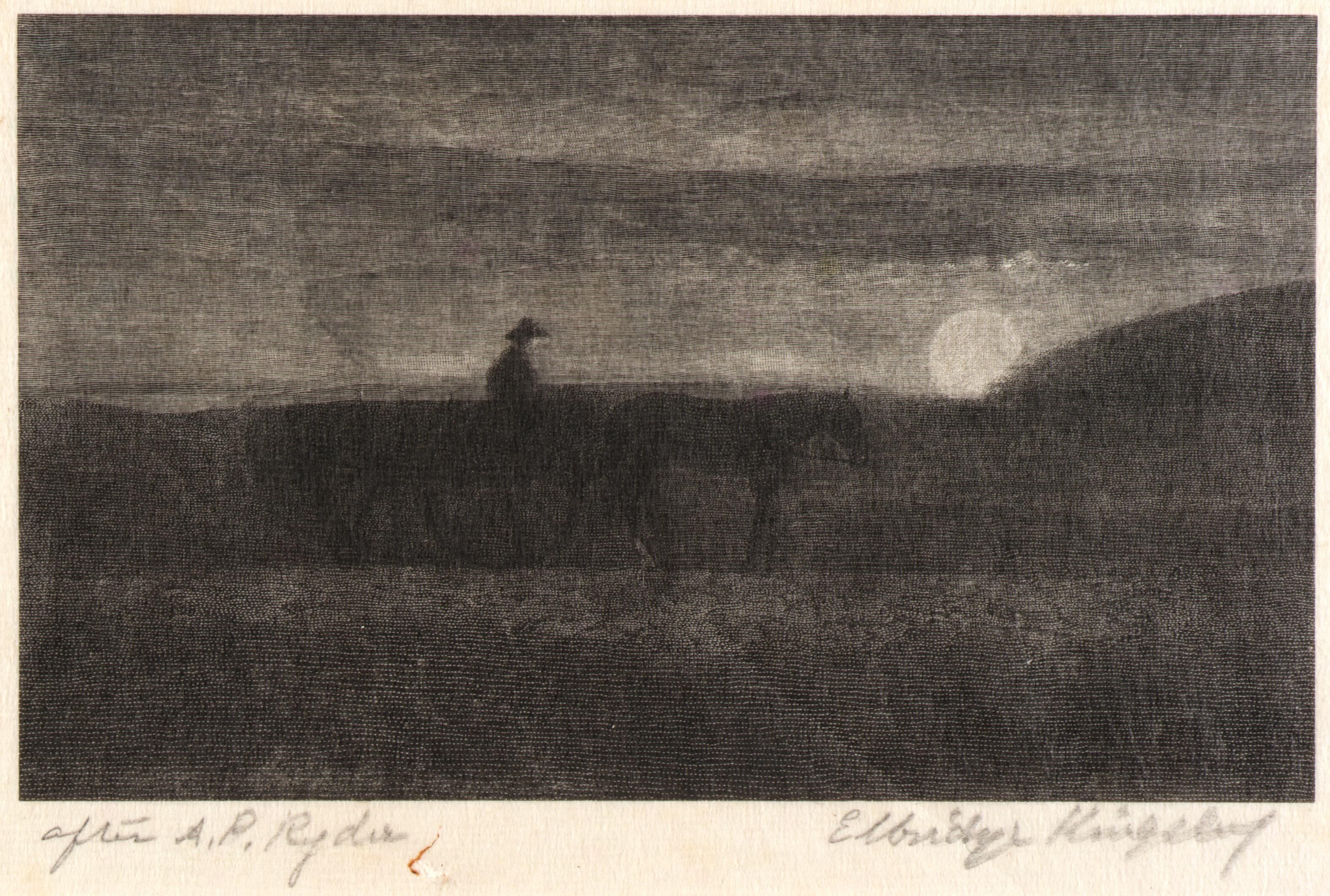
Heading image: Elbridge Kingsley after Albert Pinkham Ryder, Plodding Homeward, n.d., wood engraving, 8.3 x 13.7 cm). Public Domain, via the Smithsonian American Art Museum.
A Note from IAMCultureCare
Greetings from IAM this March!
We’re taking a brief pause from our recent focus on artistic stewardship. Mako writes below on a recent trip with Embers International and reflects on the artist’s persistent call in response to (global) trauma.
Meanwhile, I’m reading Moby Dick again, and lest such an admission be seen as a Great American Novel™ humble brag let me say that it’s part of a very doable 9‑month online reading group. As I can’t seem to keep my reading from bleeding into the rest of my life, though (probably something worth pondering this Lent as we consider the various voices we entertain by default; not all have our best interests at heart), my apologies in advance for the unnecessary streams of semicolons or nautical references that slip past my editorial spyglass in the months ahead.
This book consistently delights and surprises me with its humor and in those lines of deep significance that jump off the page, appearing suddenly and seemingly out of nowhere. One such is the following, a reference to the inimitable Queequeg’s island home:
“It is not down on any map; true places never are.”
Isolated here, stripped of significance, this quote sounds more like a campy, overused tagline you might find on a travel blog — akin to another bane of my literary existence, Tolkien’s famous “Not all who wander are lost” poem: the stuff of bumper stickers, vaguely inoffensive wall décor, and Instagram captions — and it is. But in the context of the passage, this is a sentiment which echoes true for us in a world where many lack real roots.
I don’t think I’m alone in having particular places that seem to have an outsized personal resonance given their otherwise ordinariness: a certain tree with a lovely, mottled bark I drive past on my daily commute; a house with evocatively distinctive eaves; a mossy bench on a random but somehow significant bend of a park trail. These are not searchable locations in Google Maps. But even if they were, that would not have any bearing on their unique hold — their trueness, to use Melville’s word — on my imagination. Something about them speaks to me. I know them in the same way that I know a dear friend, a way that goes beyond mere familiarity or quantitative description.
What does it mean for a place to be true? Or, a negative example: why does the efficient sameness of every suburban strip mall intuitively strike us as a cultural loss? It surely has something to do with the qualities of the place itself, and it is encouraging to see architects and city planners increasingly recognize that beauty and character matter in designing spaces that promote human flourishing. Melville’s locales in the opening chapters serve as a stark contrast to this our contemporary life, though. Whether it’s New York harbor, New Bedford, the Spouter Inn, the “Whaleman’s Chapel”, or finally the deck of the Pequod herself, he renders each location in an exaggerated but refreshingly unique reality. There are no cookie-cutter developments in 19th-century Nantucket.
But trueness is just as much about the qualities in us, and our willingness for presence, as it is in the qualities of the place. True places are inefficient to navigate (“not down on any map”) and they come with all the everyday annoyances and quirks of real life. Are we willing to enter in and accept the truth we find?
For Ishmael to succeed in his quest to go to sea, he does indeed have to navigate these locations. He has no map, no Uber or Lyft. He asks for directions. He stumbles around in the dark. Increasingly, he puts himself into physically and socially vulnerable situations, even to the point of fearing for his life: sharing a bed with a cannibal stranger whose harpoon and tomahawk lie inches away — just next to the decapitated head that he (the cannibal) had thus far failed to peddle to the residents of Massachusetts. Ishmael has to be known in order to know, has to be a relational participant rather than an observer in order to get anywhere. And, the places he interacts with are made truer by the depth of his relationship with them. We as readers cannot encounter the fleshed-out, if strange, architectural and social realities of the Spouter Inn if Ishmael does not venture into its depths.
I take it on authority that there are still people who can make their way through this world with an innate sense of cardinal direction. I am certainly not one of them, and my GPS history is embarrassingly there to prove it. My hope and expectation, though, is that in encountering works of art like Moby Dick we get a glimpse of the possibilities for truer placemaking, truer manifestations of reality for a rootless world. Art is not utilitarian. Approaching it with an outcome in mind will leave you dissatisfied both with it and with yourself. But, as I can attest to so far on this re-read, allowing it to work its way into my heart and imagination with humility reveals much-needed truth.
As Melville writes elsewhere, “Surely all this is not without meaning.”
Jacob Beaird, Editor
A Note from Makoto Fujimura
N.B. The third and final installment of Mako’s Stewardship and the Artist series, “A Renewed Vision of Artistic Leadership”, will be published in next month’s newsletter issue. Many thanks to readers who have shared their reflections on the first two essays. If you haven’t done so yet, please do reach out to continue the conversation!
* * *
We just returned from our annual trip to South Asia for Embers International, which serves 120 children and their mothers in a red light district.
Our new book “Beauty and Justice: Creating a Life of Courage and Abundance” captures in detail what we have discovered in this pursuit of justice and lasting beauty. Haejin serves as a co-founder and CEO for Embers, I serve as an artist advocate. Every time we visit, we have a heightened sense that we are coming “home to our family”. God has been opening my eyes to see beauty in the darkest realms and the miracles of the everyday lives of the children and mothers there. We are constantly reminded of our fragility, and danger lurks in the slums. As it happened, our return flight took us through Dubai just hours before the bombing of Iran began. We later learned that one of the missiles landed in Dubai, closing the airport. We were fortunate to arrive home ahead of that strike, and being able to work in the studio seems luxurious to me now.
Why art in such dark and troublesome times? Why art when the world is stricken of joy, with so many in despair?
Readers who have been following my writings over the years know that I push into this question quite directly. I am a survivor of 9/11/01, and part of my healing from that trauma has been through painting and writing. These traumatic times give writers and artists a call to journey deeply into the darkness and a necessity to practice their craft with heightened awareness. Shakespeare wrote his plays and created the Globe Theatre during the Black Plague (as the recent movie “Hamnet”, a masterpiece of visual storytelling, attests to). J.R.R. Tolkien and C.S. Lewis both experienced frontline trauma in World War I. Fra Angelico painted while a third of Europe perished in the second wave of the plague. Today, as I write this, this present darkness compels us to ask this same question: Why art?
Artists are ultimately called into a feast beyond the horizon of our traumas, and our work needs to point the way, even in the midst of despair. In a paradoxical way, this is why beauty requires justice and the pursuit of peace. But the reality is, many of us find such a time as this paralyzing, and anxiety can fill our imaginations rather than the ultimate reality of a Feast.
Sen no Rikyū (1522−1592) created a form of “Sadō” (the art of tea) that was distinctive to his Feudal War period in Japan, as I note in “Art Is: A Journey into the Light.” We at IAMCultureCare adopt Rikyu’s posture of creating an enduring art form of peace, especially during the most violent of times.
I write these words preaching to my own heart, to the many in Iran and Ukraine may be reading these words, and to many others still trapped in scarcity. I write these words (and we craft this newsletter) for “such a time as this” to encourage readers to take up their art, poetry, dance, music and theater precisely because the world is stealing that joy away, and because we might give in to our despair and not dare to step into the studio of our creativity. We want to encourage you to wildly conspire to imagine a world where all may flourish and where all that we have created will find a home, multiplied by the master Artist who calls us to such extravagance.
I came home expecting a mound of snow from the historic blizzard that hit the northeast while we were away, only to find the snow melting. Crocuses are budding their heads above the ground now. Song sparrows are turning their tunes to the sonorous melodies of the spring. Soon, mason bees will wiggle out, bottom first, from their winter tube abodes. The light is shifting, and I will be busy painting the bluebirds and tulips again. May all of us find the snow melting in our own hearts as well, and find hope in each other through the Culture Care community.
Mako Fujimura
Culture Care in Action: Song Iu's Graphic Design
I am a graphic designer at the marketing department inside a global engineering company called KBR. Last fall I received a unique request. It’s not an email newsletter or presentation which I often do, but a memorial room for an employee. Her name is Sherry Moses, an office admin, who passed away last year after working in this company for 50 years. Her manager wanted to design a memorial room with vinyl wall graphics dedicated to her.
First of all, I was moved that the manager even proposed this project. They can use this budget to do a lot of other things. It made me feel we are not just numbers on the chart, and that there are meaningful relationships built inside this profit-driven giant corporation. But now there is a challenge: how to strike a balance between corporate communication and personal intimacy. I don’t want the room to be so full of her photos that it feels like a shrine, but I also don’t want it to be so much about how great this company is that the commemoration doesn’t feel sincere.
I was put on this job to redesign what the installation vendor proposed. The emphasis was too much about the company, and the design language was cliche and uninspiring. When I first saw the photo of Sherry, I realized I had seen her on my floor chatting with coworkers not long ago. Just as Psalm 144 says: “Our life is like a breath of air. It’s like a passing shadow.” It is so fragile and fleeting, but this person made an unforgettable impact on everyone with her warm personality and big smile. To get to know her better, I read through her colleagues’ memories of her, her obituary and her twin sister’s Facebook posts. I was taught to always research well for design projects, but it’s Makoto Fujimura’s writing about “beholding”, “attentiveness” and opening the eyes of the heart to listen that brought my preparation to the next level. I thought about how dearly her family missed her, and how her passing must have left an immeasurable void in their lives.
The meeting room is quite small without any windows, so I wanted to leave generous negative space in the artwork I design so it leaves room for the viewers to take in and process. My early childhood years of painting traditional Chinese art with brushes, along with the Chinese philosophy, influenced my aesthetics today. Instead of using her photos, I used the objects which were symbols of her life journey. Upon the entry, you see a peony, which is the state flower of Indiana, Sherry’s birthplace. Then move on to the Grand Junction, where she visited, symbolizing her passion for exploration. Niagara Falls, another place she visited, symbolizes her kindness and love showing to the lives of those around her. Finally bluebonnet, the state flower of Texas, symbolizes her resting place.

Sherry Moses memorial wall graphic design, courtesy of Song Iu / KBR. Used with permission.
How fitting the Kintsugi golden line is for threading the graphics together! Like how the Japanese artists mend the shattered ceramic pieces with the golden lacquer, I am mending the broken hearts caused by the loss of their loved one. Especially for the family of Sherry Moses who knows the Lord, I want them to remember there is hope. Like the poet Luci Shaw said, we don’t die to death, we die to life. Kintsugi doesn’t only repair the broken vessel, it makes the fragments into a new work of art which is more beautiful and valued than the original. Sherry has passed and that is the cruel reality we can’t change, but her legacy lives on. Hopefully by creating this room, her light will touch more people than her physical being.
Along with dedicating the room, the committee also presented some gifts to the family. We chose a standing metal print display and a set of coasters that are the miniature versions of the wall graphics. When displayed side by side, the Kintsugi golden line runs across all four coasters, echoing the same linear journey as you step into the meeting room space. Sherry’s family probably will never know all the thoughts that went behind it, but hopefully they can see a glimpse of beauty as part of the final result, and the grace that God has shown to us all.
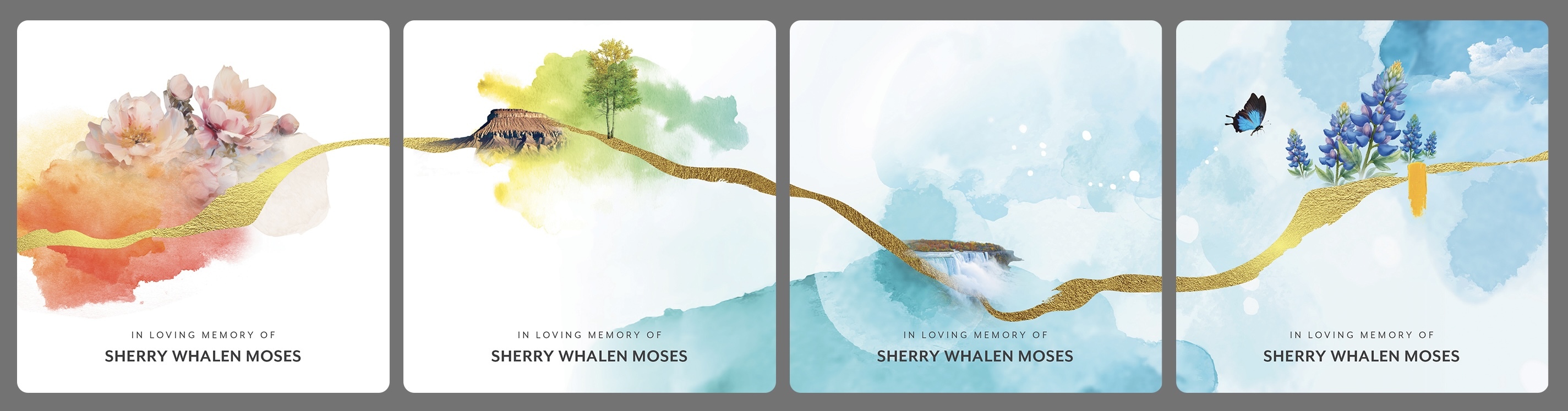
Sherry Moses memorial coasters design, courtesy of Song Iu / KBR. Used with permission.
I have been struggling with my calling as a graphic designer, and my work seems only to feed this utilitarian and transactional world. I will probably always wrestle with the meaning behind what I do. This is part of the journey on this side of eternity, when we can never reach perfection and have a very limited understanding of infinity. Yet by knowing a community of artists who are on the same journey with me, it feels less lonely. Once in a while, I get to do a project that has a lasting effect or really touches someone’s heart. It is not just pleasing to the eyes, which is a miracle by itself that God created all of us to appreciate beauty, but connects with other humans on a deeper level. The project manager told me today that since the graphics were installed, various visitors stopped by and some of them just started crying once they were in the room. I assume they knew Sherry and this design just provided them an outlet to express their sorrow, a beginning of the healing process, or a closure of deep grieving. Either way, it is meaningful to me, and I am grateful to be part of it.
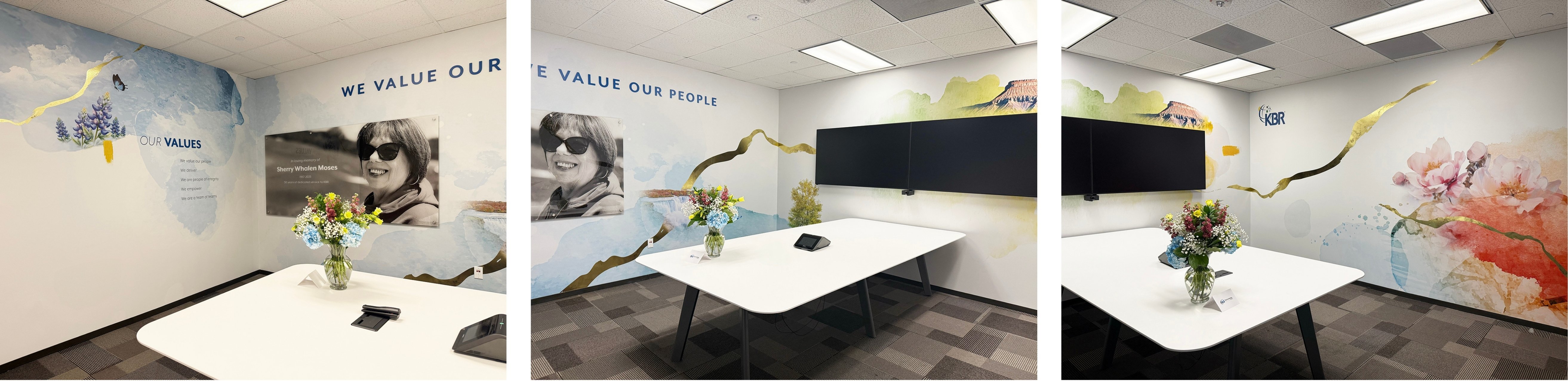
Photos by Song Iu. Used with permission.
Song Iu is an award-winning graphic designer with over 15 years of experience in branding, illustration, storyboarding, and UI/UX design. She also spent a year teaching as an adjunct professor at local universities. Though teaching was a brief chapter in her career, she still receives an occasional ‘hello’ from former students which never fail to make her heart sing. Outside of work, she is busy trying to keep her three young boys out of trouble.
Culture Care Events & Announcements
- “Dust and Gold — Makoto Fujimura & Shozo Michikawa” Exhibition—ALIEN ART CENTRE, Taiwan, Now-August 30, 2026. Major works by Mako Fujimura are exhibited in dialogue with sculptor Shozo Michikawa in an expansive two-part exhibit — each part lasting six months — reflecting on time and impermanence. The first“Luminous Chapter” invites viewers to explore the question“How is light born?”, and to discover the potential for healing and renewal. The“Formative Chapter” (beginning in April) asks“How does force take shape?”, guiding viewers to explore the gestures behind the works and how time leaves its mark.
- “Art Is: A Journey into the Light” Lecture & Reception—Yale University, New Haven CT, March 29, 2026. The St. Thomas More Center at Yale University welcomes Makoto Fujimura to give the RESCHEDULED Vincent, Jr. Fellowship in Faith and Culture lecture. Mako will share about the process of writing as a visual artist, drawing from his books to ask questions like,“What does it mean to be‘called’ as an artist?”“What does it mean to create beauty today (especially in contemporary art)?” And,“What does it mean to develop a‘sanctified imagination’?” While regular tickets are sold out, students can still get tickets and the lecture will be live-streamed.
- “Beauty and Justice” Author Event — Lancaster PA, May 1, 2026. The Row House and Bucknell University’s Open Discourse Coalition present an evening with Mako & Haejin Fujimura on the subject of their new book, Beauty x Justice: Creating a Life of Abundance and Courage.
- Culture Care: Reconnecting with Beauty for our Common Life 2nd edition to be published July, 2026. Mako Fujimura’s original Culture Care thesis is revised and expanded, featuring additional chapters on generative thinking and Culture Care as public theology, a new introduction, foreword by David Brooks, afterword by Mark Labberton, and fresh insights and stories of Culture Care in action from the years since the original 2017 publication. Available for pre-order now at the link above.
Do you have a news item or upcoming culture care event? Consider sharing it with us for a possible feature here in the newsletter! Email jacob@internationalartsmovement.org.
Web Links
- Latest Belonging Conversation from Mako Fujimura and Julia Hendrickson.
- Susannah Black Roberts goes to sea.
- Nick Cave on art and politics.
- The art of Sr. Mary Corita.
- Joshua Luke Smith’s poem for Lent.
- Joy Clarkson interviews Haejin and Mako Fujimura for Plough’s “Another Life” podcast.
- Unsolved medieval mysteries.
- Using AI to identify the lost rules of an ancient board game.
- Our friends at Windrider Studios (and IAMCC board member Bruce Shaw) have just released a new documentary film on Adam Smith.
- New music rec: Johanna Rose’s evocative viola da gamba playing on “Visions du Diable”.
IAMCultureCare is a registered 501c(3) non-profit organization which relies on your support to continue our“Culture Care” work amending the soil of culture as an antidote to toxic culture wars. We welcome gifts of any size to continue these efforts. You can donate online or get in touch with us about corporate sponsorship and other giving methods! You can also support IAMCC’s work with a paid subscription to Makoto Fujimura’s Substack.
All content in this newsletter belongs to the respective creators, as noted, and is used with permission. If you would like to submit something for consideration in a future newsletter issue, you may do so by filling out this form or by emailing jacob@internationalartsmovement.org.