“Culture Care begins with a counter-intuitive premise: that abundance, not scarcity, is the proper posture of the cultural worker. That the maker’s task is not to produce for a market but to tend — to cultivate, to care for, the commons of human meaning.”
– Makoto Fujimura
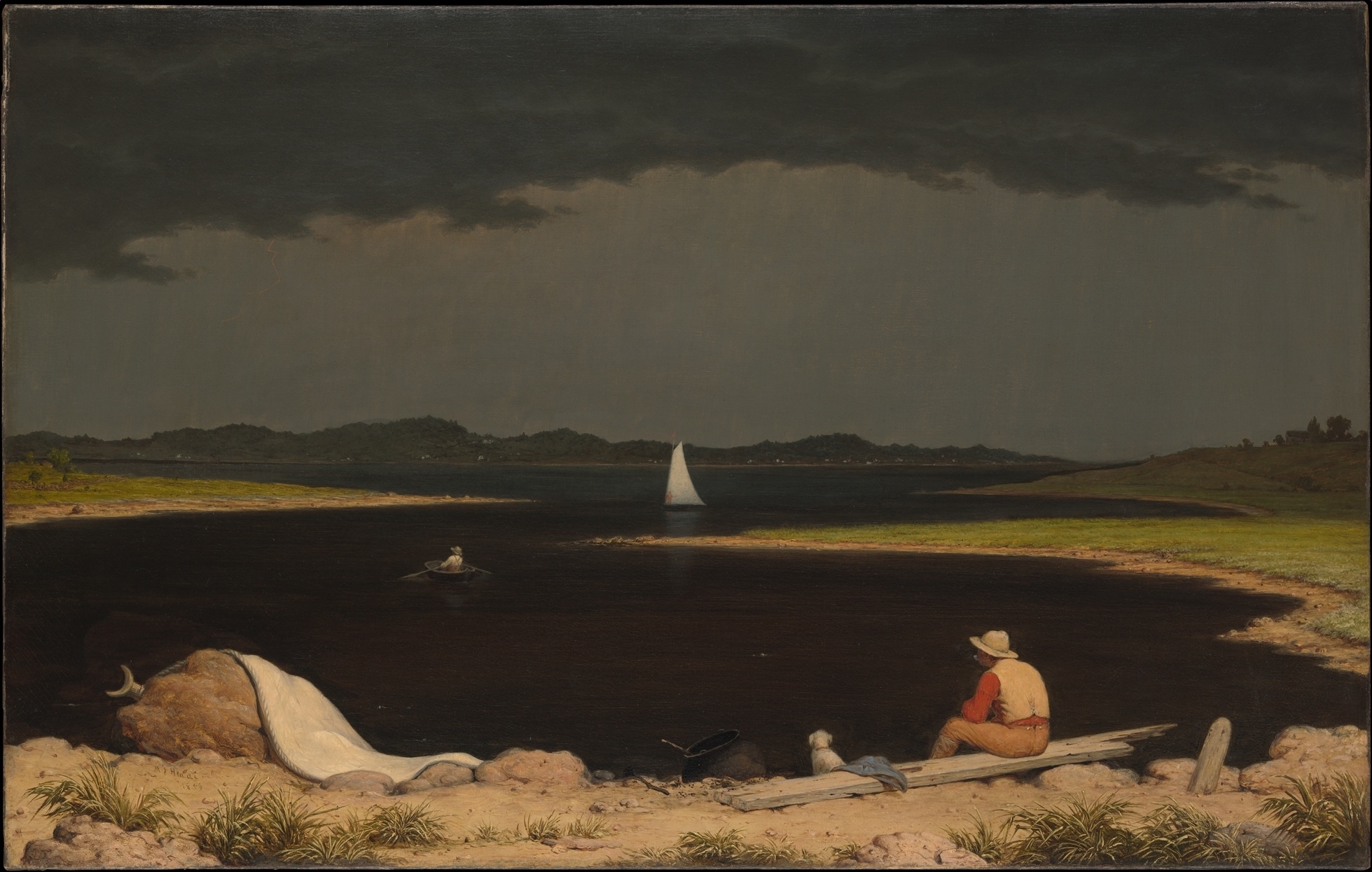
Heading image: Martin Johnson Heade (1819 – 1904), Approaching Thunder Storm, 1859, oil on canvas, 28 x 44in. Public Domain, via the Metropolitan Museum of Art.
A Note from IAMCultureCare
I don’t know about you, but I’m sort of getting tired of the whole AI discussion. Several years on, the models are better and better but have yet to fulfill the transhumanist utopia that tech bros promise. Meanwhile, the reactions to the loss of creative agency and unique human identity that artificial intelligence engenders from seemingly every corner of society — from your average Luddite to the Pope — while thoughtful, (and, I think, largely correct), have yet to result in meaningful safeguards. AI is useful as ever, dangerous as ever, and divisive as ever.
As an older member of Gen‑Z, I wonder if there were similar anxieties and ecstasies at the dawn of the internet revolution. Perhaps some of you readers who were alive during that era might write in and let me know. What I am surprised by, though, is the sorts of arguments for or against AI, especially vis-à-vis the nature of what it ostensibly offers a solution to: human labor. Proponents look to AI as an incredibly helpful tool; it is. Opponents affirm the value of human creativity and identity, pointing to the exploitative results of AI on culture, the environment, employment, or — in the case of autonomous warfare — human life. These concerns are real too, but likewise focus on the external effects of AI rather than more fundamental questions of telos: What is a human being, and what is (or what ought to be) the relationship between that human person and his or her work?
These, to me, are much more interesting questions. They are also much too big to adequately answer in a format like this, but I will briefly outline some thoughts on the latter. Mako (echoing the Pope) implicitly touches on the former in his column, below.
I’d argue that according to the creation account in Genesis 1 and 2, human beings are made to work, and more specifically, to complete or maintain the creative work that God had initiated. That’s a metaphysical rather than a quantifiable claim, but if you take any wisdom from the biblical narrative, it’s worth pondering. God creates a human being and immediately places him in a garden to “work it and keep it”. Further, Adam is then given the task of naming the rest of the animals; in other words, creative work. The passage implies that there is something inherently human to these dual vocations of physical and creative labor, body and mind, and that God — at least in part — created humankind for this holistic sort of work. Crucially though, this vocation also includes a call to rest, as the passage reminds us in the repeated Sabbath refrain. Both work — physical and creative — and rest are part of the human telos, our fulfilling purpose.
To be clear, AI is not a unique threat to these dual physical/creative and work/rest vocational realities. New technologies have always presented new opportunities to degrade and abuse. But AI is our technology with implications for our present culture. And that culture we find ourselves in is a professionalized, white-collar-led society that values mental/creative work over the physical; it thus (often exploitively) outsources that physical labor to underpaid migrant workers, those with disability, or machines. In this vision for humanity, work is something to be eliminated. AI simply offers the natural next step in that outsourcing process: an invitation to now transcend mental/creative work as we did the bodily/physical, a final shortcut to the Sabbath rest for which we long but can no longer name. The unasked question is, can we have that true rest without the work that precedes it?
Of course, as with any new technology, both the fears and the hopes that AI provoke are likely to be far less urgent and far more diffuse than they initially purport. And as with any new technology, I trust we will figure out how to live alongside it in meaningfully human ways as we have the plow, the novel, or the internet. But here, now, less than four years since OpenAI catapulted AI into the public consciousness with the release of ChatGPT, we have a lot of figuring out still to do — especially given the speed and scale of adoption. How do we care for culture in this fragmented reality?
It will be no surprise to hear that I think artists have something of an answer. That’s because on a fundamental level, an artist inhabits the full vocation of work that the rest of us have largely forgotten. Creating a work of enduring value requires work, both physical and creative. Mind and body, imagination and paint brush, an artwork is birthed through real labor. Artificial intelligence can generate the semblance of reality, but it requires this labor of love to reveal that which is truly, deeply Real. There is something mysterious to the Genesis story in which an all-powerful creator God brings a perfect, good universe into being only to leave it seemingly incomplete: the garden God plants requires a human to work it; the animals God creates require a human to name them for the fullness of their reality to be unfolded. An artist is engaged in the work of revelation, for which there is no shortcut.
An artist also knows when it is time to rest from work. Bruce Herman has written lately of his making process and how he will paint and paint only to scrape much of it away and paint some more. It takes real courage and skill to sense when there is exactly the right amount of paint on the canvas, that to add a single additional brushstroke would be to somehow obscure what has just been revealed. I find it telling that much of what I dislike about AI writing is that, much like a high school student trying to hit a word count minutes before a deadline, it doesn’t know when to stop. Its platitudes obscure any real substance; it cannot self-critique. The work of the artist is thus also the work of humility and wisdom: an artist knows their limits and recognizes them as a good.
A final brief word on disability: in arguing that the human telos should account for work, I am not saying that those unable to work in physical or creative ways are in any way less human or have any less intrinsic worth. We need to recognize both universal human dignity and the fallen reality that disability points to. But I also wonder if there is a different sort of work that those with mental or physical disability are engaged in, and if it is only an efficiency-obsessed culture like ours that is blind to it. Saint Paul in 1 Corinthians 12 might have a thing or two to say about that. Certainly our conception of work must be more than the industrial sum total of those activities which contribute to the Gross Domestic Product. Mako’s theology of making is helpful here, and rather than “work” or “labor”, “making” might be a better term in this discussion.
Regardless, where I’m left is simply this: I’m committed to human work. That isn’t to say I won’t ever use AI; I do and will continue to for some, specific tasks until I find evidence that it is so thoroughly corrupt(ing) that I can’t in good conscience keep it in my toolbox. But I won’t use it for meaningfully human, relational tasks like writing, seeking counsel, creating “art”, or passing AI work off as my own. I also only use AI with a recognition that I may be losing out on some experience of reality I might have otherwise encountered. But that’s as true of using AI over a cooking class as it is of using a Google search over a library visit or using a power tool over a hand saw. Each of these, in their own way, teach us something about ourselves and the world we inhabit. There are very few choices in life that come without a cost. “The medium is the message”, and the path of wisdom — of culture care — is choosing those things that contribute to a flourishing human life.
Jacob Beaird, Editor
A Note from Mako Fujimura, Founder of IAMCultureCare
On Pope Leo XIV’s Magnifica Humanitas and the Dignity of the Maker
On May 15, 2026, Pope Leo XIV released Magnifica Humanitas—‘The Grandeur of Humanity’ — an encyclical addressed to a world accelerating, without consensus, into the age of artificial intelligence. I read it in the studio the day it came out while preparing to apply the first ground of azurite to a newly commissioned canvas with slow manual care. This type of document requires such attentiveness
The document is vast — five chapters tracing the arc of Catholic Social Doctrine from Leo XIII’s Rerum Novarum through Francis’s Laudato Si’, then bringing that entire tradition to bear on the present technological transformation. But two images animate everything Leo XIV writes, and they are effective. The first is Babel — a project of engineered uniformity, self-naming power, and the erasure of difference in the name of efficiency. The second is Nehemiah rebuilding Jerusalem’s walls (described in Nehemiah chapters 1 – 7) — an act of shared, attentive, distributed care, where each family holds a section of the wall, and the city is reborn not by a single architect but by the gathered faithfulness of many.
These are not abstract biblical typologies. These two images describe two entirely different relationships to making. Both Popes warn us against using our imagination to create idols of our age that lead to destruction, and they illuminate our journey of cultural care, which is the Nehemiah path of rebuilding. Magnifica Humanitas focuses strikingly on culture care paths. Along with Pope Francis’s Laudatory Si’ (which Dr. Thomas Hibbs of Baylor University reviewed from a culture care perspective — see “A Theology of Creation: Ecology, Art, and Laudato Si’) these encyclicals have provided this movement with significant guidance and support.
The Technocratic Paradigm and the Kenotic Alternative
Leo XIV draws heavily on Francis’s concept of the ‘technocratic paradigm’ — the tendency to let efficiency, control, and profit become the sole logic governing human decisions. He extends this analysis to AI directly: when the architecture of artificial intelligence is designed to maximize performance, to optimize outputs, to render the human person as a data-point to be processed, we are not simply facing a technical problem. We are facing a spiritual one.
Culture Care addresses such a ubiquitous modern predicament. Culture Care begins with a counter-intuitive premise: that abundance, not scarcity, is the proper posture of the cultural worker. That the maker’s task is not to produce for a market but to tend — to cultivate, to care for, the commons of human meaning. The technocratic paradigm is, at its root, a scarcity posture. It assumes that efficiency is virtue, that speed is progress, that measurable output is the only worth. Leo XIV names it a ‘Babel syndrome’ — the idolatry of profit that sacrifices the weak, a uniformity that neutralizes difference, a pretense that even the mystery of persons can be translated into data and performance.
What the encyclical does not develop — but which a Theology of Making must — is the kenotic alternative. When I speak of Nihonga, of the slow application of mineral pigments that cannot be rushed, of layers that must cure before the next can be laid down, I am practicing a form of making that refuses the technocratic paradigm at the level of method. The pulverized, broken beauty does not cause inefficiency; rather, it is the breath of the work. It is where meaning lives.
Jacques Maritain wrote that the habitus of art is a kind of virtue, a formed capacity of the whole person oriented toward the good of the work. Artificial intelligence does not have habitus. It has parameters. To a human, these are not the same thing, even though they may look identical to a machine. What Leo XIV calls the ‘grandeur of humanity’ is precisely this capacity to form, over time, a posture toward making that is accountable to beauty, to truth, to the neighbor — a posture that no training dataset can replicate, because it emerges from the whole of a human life lived before God.
Image-Bearing and the Making of Culture
At the theological center of Magnifica Humanitas is a retrieval of the imago Dei — the human person as image of the Triune God. Leo XIV insists that human dignity does not depend on ability, wealth, productivity, or efficiency. It is ontological: given before achievement, prior to usefulness, grounded in the love of the One who wills each person into being. It is charis, grace, lived out in our days.
This is a Culture Care claim as much as a techno-social doctrine claim. When I developed the framework of Culture Care, one of its deepest impulses was to resist the reduction of persons to their cultural utility: their productivity, their platform, their measurable influence. Tending to culture requires a different orientation than optimizing it.
Leo XIV goes further. He argues that the universal destination of goods — traditionally applied to material resources — now extends to digital infrastructure, algorithms, data, and platforms. These too are meant for all. Their concentration in the hands of a few is not merely an economic injustice; it is a theological distortion of what goods are for. Culture care workers have long known this intuitively. When culture’s distribution networks are owned by entities whose only accountability is to quarterly returns and elitist exclusivity, the cultural commons does not merely become impoverished. It becomes colonized. Culture is generative by nature, just as nature itself is.
The encyclical’s emphasis on the common good and its subsidiary nature — that it is ‘greater than the sum of its parts’ — resonates with something I have long believed about the studio: the individual work of art, however particular, participates in something beyond itself. Nihonga emerged from generations of masters; my own practice carries those logoi — those shaping reasons, to use the language of Maximus the Confessor — even when I cannot name them. The work is never only mine. And this is its dignity, not its diminishment.
The Machine Cannot Layer
Leo XIV writes that ‘the splendor of humanity is something no machine can replace.’ He does not say this as a technological pessimist — he is careful, throughout, to affirm that AI is a genuine gift, a talent to be stewarded (Mt 25:14 – 30). But he is equally clear that the gift can be misused, and that the misuse is already visible in the normalization of surveillance, in the erosion of the dignity of work, in the way that algorithmic systems can perpetuate injustice not through malice but through the encoded assumptions of their makers.
The insight I want to carry forward into Part Two of this series is this: what the machine cannot do is layer. Not in the sense that AI cannot produce layered images — it can. But it cannot live through the layers. It cannot know the grief embedded between the second and the third, what my whole being has cried out toward, obscuring and even erasing what the second layer had achieved. It cannot hold the tension between what is being covered and what is being revealed. It gave no sacrifice.
The Theology of Making that I have been developing across my books — from Art+Faith (explicitly) to Art Is (implicitly) — rests on this conviction: that the maker’s vulnerability is not a deficiency. It is the very mechanism by which the work can speak to other vulnerabilities. When Endō wrote about Father Rodrigues’s silence in the face of apostasy, he was writing from a place of his own unresolved silence. AI has no biography and no history of pain.
This does not mean AI cannot be used. It means that the question of who uses it, from what posture, in service of what love — remains irreducibly human. It is the question of imagination: how to develop a sanctified imagination filled with the fruit of the Spirit. And it is precisely this irreducible humanness that Leo XIV is trying to protect.
Mako Fujimura
Culture Care Events & Announcements
- Job Opportunity — Creative Officer. Apply to work for IAMCultureCare! This full-time, in-person only role in New Jersey is a dual administrative/creative position reporting directly to Makoto and Haejin Fujimura to support the integrated network of organizations they collectively run, including IAMCultureCare, Fujimura Contemporary, Culture Care Creative, and Shim & Associates. To receive the job description and apply, please email admin@shimassociates.com. Applications will be reviewed on a rolling basis.
- “Dust and Gold — Makoto Fujimura & Shozo Michikawa” Exhibition—ALIEN ART CENTRE, Taiwan, Now-August 30, 2026. Major works by Mako Fujimura are exhibited in dialogue with sculptor Shozo Michikawa in an expansive two-part exhibit — each part lasting six months — reflecting on time and impermanence. The first“Luminous Chapter” invited viewers to explore the question“How is light born?”, and to discover the potential for healing and renewal. The“Formative Chapter” (now open) asks“How does force take shape?”, guiding viewers to explore the gestures behind the works and how time leaves its mark.
- Beauty x Justice: Creating a Life of Abundance and Courage Available Now. Makoto & Haejin Fujimura’s co-authored book on the relationship between beauty and justice is out now and available wherever good books are sold. Through stories from their global work in the arts, advocacy, and cultural renewal, the authors reveal that beauty isn’t a luxury — it’s essential to effective, lasting justice work. Beauty has the power to heal, and justice becomes most compelling when it is truly beautiful. Byron Borger of Hearts and Minds reviews the book.
- Culture Care: Reconnecting with Beauty for our Common Life 2nd edition to be published July, 2026. Mako Fujimura’s original Culture Care thesis is revised and expanded, featuring additional chapters on generative thinking and Culture Care as public theology, a new introduction, foreword by David Brooks, afterword by Mark Labberton, and fresh insights and stories of Culture Care in action from the years since the original 2017 publication. Available for pre-order now at the link above.
- TALER & TALAR Conference—Germany, Sept 2 – 4. Mako and Haejin Fujimura will both speak at this upcoming conference held at the historic Kloster Volkenroda in Thuringia, Germany.
- RENEW 2026: Courageous Creativity—Washington DC, Sept 24 – 25. Mako Fujimura will give a keynote lecture at Dream Collective’s annual conference, a“two day gathering for pastors, creatives, entrepreneurs, and thought leaders allowing their faith to take visible form through beauty, leadership, and action. This year, we will explore Courageous Creativity: what does it take to cultivate a bold faith that shapes culture?”
Do you have a news item or upcoming culture care event? Consider sharing it with us for a possible feature here in the newsletter! Email editor@internationalartsmovement.org.
Web Links
- Latest Belonging Conversation from Mako Fujimura and Julia Hendrickson.
- Missed Mako and Haejin’s live discussion on “Beauty x Justice” for Trinity Forum last month? The recording is now available.
- Preservation versus exhibition: the Munch paintings that will one day disappear.
- An AI bot that matches a Rothko work to your local weather forecast.
- N. Angel Pinillos makes a utilitarian case for studying the humanities.
- Tolkien’s newly-discovered translation of a sermon in Middle English.
- The Public Domain Review chronicles historical typesetting races.
- New music recs: “or, The Whale”, Caroline Shaw and Andrew Yee’s soundtrack to a Moby Dick-inspired short film; a self-titled sophomore album by Cala, a “post-traditional” Scottish funk-folk-rock band; French Canadian folk group La Famille LeBlanc’s “Amourette”; Renee Fleming and Bela Fleck record bluegrass folk tunes in “The Fiddle and the Drum” (reviewed by NPR).
IAMCultureCare is a registered 501c(3) non-profit organization which relies on your support to continue our“Culture Care” work amending the soil of culture as an antidote to toxic culture wars. We welcome gifts of any size to continue these efforts. You can donate online or get in touch with us about corporate sponsorship and other giving methods! You can also support IAMCC’s work with a paid subscription to Makoto Fujimura’s Substack.
All content in this newsletter belongs to the respective creators, as noted, and is used with permission. If you would like to submit something for consideration in a future newsletter issue, you may do so by filling out this form or by emailing jacob@internationalartsmovement.org.