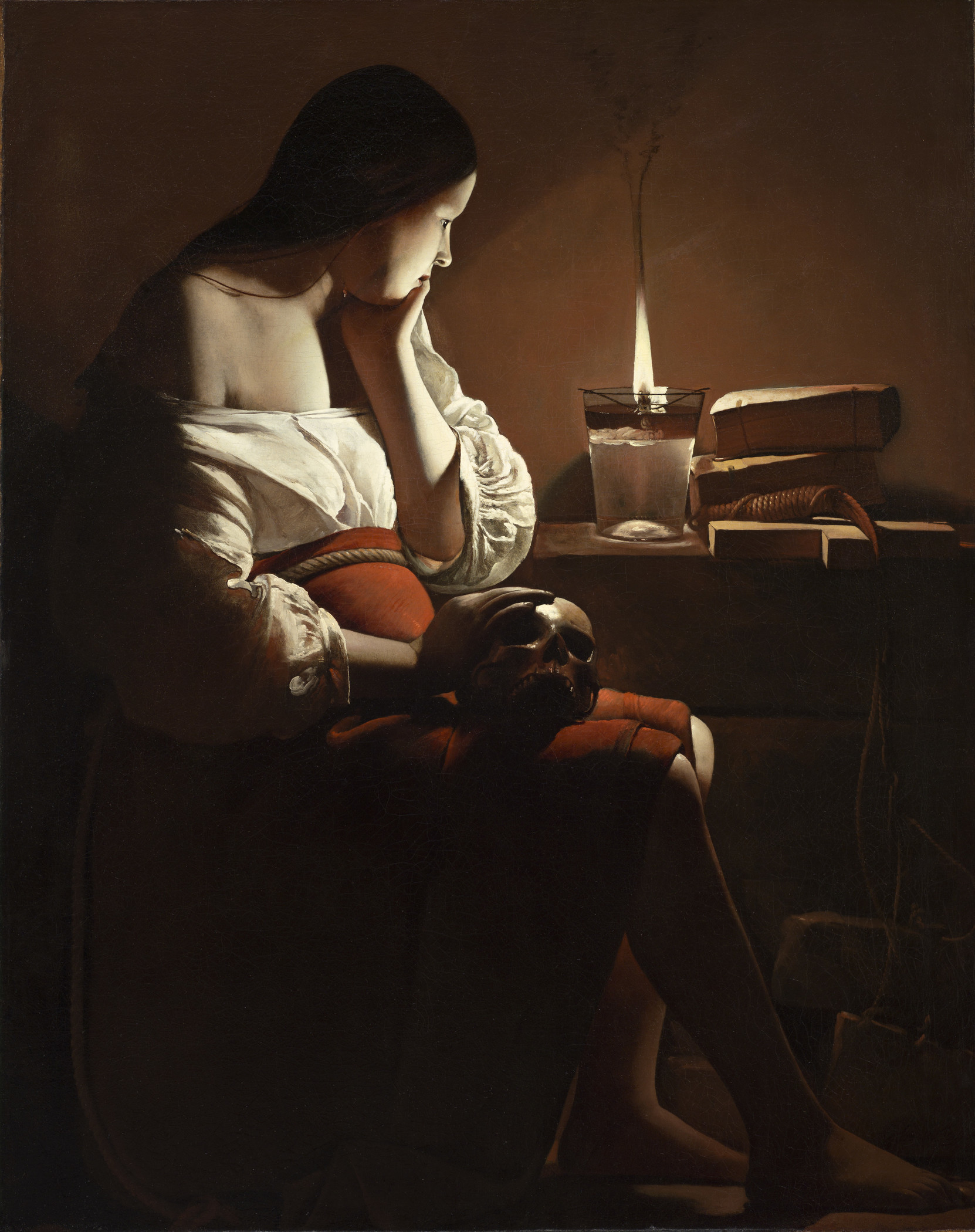
“The act of making in the Advent season is itself waiting for the apocalypse — not the end of the world, but its unveiling.”
– Makoto Fujimura
Heading image: Georges de La Tour (1593−1652), The Magdalen with the Smoking Flame, c.1635 – 1637, oil on canvas, 117 x 91.76 cm. Public Domain, courtesy of the Los Angeles County Museum of Art.
A Note from IAMCultureCare
It’s hard to wait—
At least for me, the most difficult part of any musical performance is not the act of performing itself but rather the waiting beforehand. It’s that weird, almost out-of-body feeling of nervous anticipation: the uncomfortable minutes backstage, shifting from one foot to another for some relief from the painful black shoes I seem to wear only for concerts and funerals (which will this be?). It’s being forced to come face-to-face with the unknown, uncertain if anyone has even shown up (and if so, how many?); uncertain if the first sounds we collectively make will be a nervous, faltering disaster or something beautiful, profound (there is no middle ground); uncertain if the audience can even tell the difference between the two. Voices are hushed, not out of respect for thin walls and minimal soundproofing but from the swirling inner anxieties of each individual, physically together in a cramped hallway but psychologically worlds apart and utterly alone. Someone cracks a joke; no one really laughs.
And yet the mystery of this art is that we can’t create beauty without those moments of presence in the dark. We have to start from nothing. Of course, it’s not completely creation ex nihilo—we’ve rehearsed, sometimes for months, and are even now working out of a score which is itself an amalgamation of all the learned quirks and traditions of musical history — but it sure feels like it in the twilight of backstage. How could we ever make something out of this emptiness? And yet it happens. We step onto stage. There is a gesture, a collective breath — then resonance. Beauty is born, borne on waves of sound and light, leaping into the ears, eyes, and hearts of the audience. We who make behold the void that an audience might behold presence.
It is not insignificant that the church’s new year begins in this void of waiting. Advent — “coming” — exists in (at least) three parallel dimensions. There is the historic coming of Christ into the world as a human being, God incarnate (literally in-fleshed), largely unnoticed and unappreciated in a little backwater of the Roman Empire. Then, more expansively, the present coming to the hearts of those who are attentive to the call. And thirdly, the coming of the apocalypse — that final and cosmic revealing — which Mako writes more on below. Advent intentionally sits in all three, waiting in acknowledgement that there is something beyond what we time-bound beings can presently grasp or control. We start each year with an eye toward the end.
This is ultimately a culture care practice, this posture of patient humility before multiple overlapping, still-being-completed realities. We must be willing to see beyond a single reference point, to transcend knee-jerk responses to discomfort, to behold the void. To sit in this uncomfortable, liminal hallway together, trusting that there is something greater on the other side of this present darkness. There is hope, but as someone wiser than I once wrote, “the faith and the love and the hope are all in the waiting.”
Jacob Beaird, Editor
A Note from Mako Fujimura, Founder of IAMCultureCare
I want to thank all of you for your support for Art Is: A Journey into the Light—now an award-winning book offered to the world. I wrote the following in my Substack feed:
I was honored and humbled to receive the Culture, Poetry & the Arts Book of the Year award from Christianity Today Magazine. I am grateful for the dear sojourners, many of whom are mentioned in the book, also receiving this note.
An artist’s journey is one which is often not recognized or valued. We labor on, believing that someone out there may appreciate what we have been asked to steward faithfully. We create, even though there is no guarantee of an audience. When it is recognized, then we can assume that it is a note given to all of us who work with our hands, to create beauty despite being told “no” many times, even though the darkness pushes against it.
* * *
Advent, the season of holy waiting, is not simply a passive stretch of time, but can rather be a generative and creative time of gestation. We journey into this “mini Lent”, restrained in our anticipation and longing, charged with the weight of invisible things. As we speak of a baby wrapped in swaddling cloths, we also anticipate the opening of the scroll, for the veil to be torn, for the world to be re-formed by beauty and justice. We wait for revealment—the true meaning of Apocalypse, that oft-misunderstood word. Not destruction, but unveiling.
The Advent panels at All Saints (I have a chapter on these liturgical panels in my new book Art Is: A Journey into the Light), painted years ago now, were born from this paradox: to paint what cannot yet be seen. They were composed in the quiet of expectation, in the in-between twilight of fading light and the first rays of new dawn. Using Nihonga materials — pigments made from pulverized minerals like cinnabar and vermillion — I prayed through the preparation process. Cinnabar, vermillion, deep and luminous, are not simply colors; they carry the weight of time embedded in fragmented matter, pigments of prayers.

“Advent & Pentecost I” diptych, 2016 – 2017, Mineral pigments, gold, and cinnabar on canvas, 48 x 144 in. Copyright © 2017 Makoto Fujimura. Used with permission. Read more about the Liturgical Panels series at the project page here.
These panels quietly disclose themselves to those who behold them with the hospitality of their time, as they begin to speak in whispers. One must allow their eyes to adjust as if to peek beyond the darkness. Then, layers long submerged begin to surface. Tensions between color fields and weighty minerals emerge on the depth of the layers. The gold specks wink with hidden light, responding to the movement of the viewer, like the Spirit itself: ungraspable, yet always present.
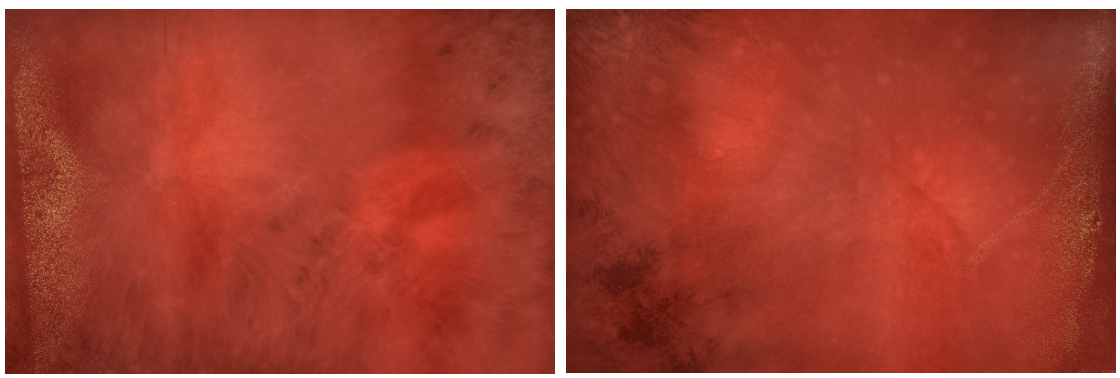
“Advent & Pentecost II” diptych, 2016 – 2017, Mineral pigments, gold, and cinnabar on canvas, 48 x 144 in. Copyright © 2017 Makoto Fujimura. Used with permission.
Time has worked on these paintings, as it does on all art that seeks eternity. They have deepened. The materials themselves have aged, yes, but more than that they have begun to resonate with the prayers and presence of those who have stood (or sang, as the choir stands in front of them) before them over the years. In that way, they are not complete, but completing. They are not finished, but finishing.
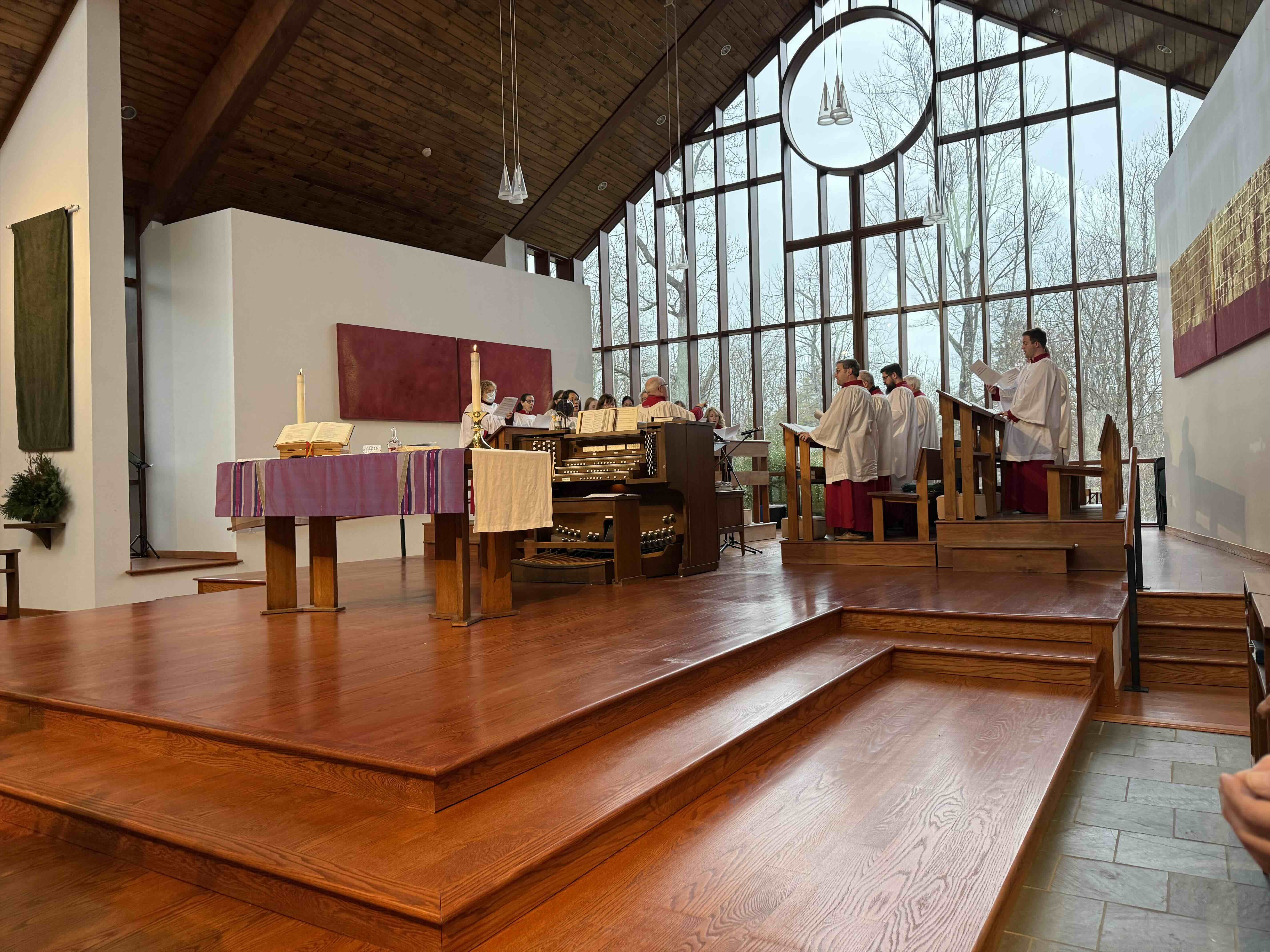
All Saints’ Choir singing in front of the Advent liturgical altarpiece panels. Photo by Mako Fujimura, used with permission.
The act of making in the Advent season is itself waiting for the apocalypse — not the end of the world, but its unveiling. The gold that flows downward becomes an icon of grace — grace not earned or achieved, but given, descending like manna, like Christ himself — His Broken Body into our fragmentary world.
To make is to trust that what we do not see now will one day be revealed. And so these panels remain — silent, gilded witnesses to this hope: that in our waiting, something is always being born.
Yours for Culture Care,
Mako Fujimura
Culture Care Events & Announcements
- “Dust and Gold — Makoto Fujimura & Shozo Michikawa” Exhibition—ALIEN ART CENTRE, Taiwan, September 28, 2025-August 30, 2026. Major works by Mako Fujimura are exhibited in dialogue with sculptor Shozo Michikawa in an expansive two-part exhibit — each part lasting six months — reflecting on time and impermanence. The first“Luminous Chapter” invites viewers to explore the question“How is light born?”, and to discover the potential for healing and renewal. The“Formative Chapter” (beginning in April) asks“How does force take shape?”, guiding viewers to explore the gestures behind the works and how time leaves its mark.
- “Do Science & Imagination Have Anything in Common?” Lecture & Book Signing, Makoto Fujimura and Kerry Magruder— Princeton, NJ, Dec 13 @2:00PM. What do science and the imagination share? Goldenwood Institute presents this conversation between Mako Fujimura and historian of science Kerry Magruder exploring how the history of scientific discovery — from early evangelical geologists to Charles Darwin — reveals a vision of the world shaped not by control, but by curiosity, faith, and awe. This event invites all — scientists, artists, theologians, and seekers alike — to join a dialogue at the intersection of faith, imagination, and the making of meaning. Registration required at the link above.
- Windrider Summit at Sundance — Park City, UT, January 25 – 30. Join the Windrider Institute in its annual Summit at the Sundance Film Festival. The Windrider Summit is a one-of-a-kind cultural experience. It is an opportunity to attend the premiere festival for independent films and interact with a community who shares a belief in the transformative power of story. It is also a chance to bring a distinctively spiritual and theological lens to film and explore some of the most important topics in our culture. Register at the link above.
- Culture Care: Reconnecting with Beauty for our Common Life 2nd edition to be published July, 2026. Mako Fujimura’s original Culture Care thesis is revised and expanded, featuring additional chapters on generative thinking and Culture Care as public theology, a new introduction, foreword and afterword, and fresh insights and stories of Culture Care in action from the years since the original 2017 publication. Available for pre-order now at the link above.
Do you have a news item or upcoming culture care event? Consider sharing it with us for a possible feature here in the newsletter! Email jacob@internationalartsmovement.org.
Web Links
- The latest Belonging Conversation from Mako Fujimura & Julia Hendrickson.
- A great example of beauty and justice in action, the Audubon Mural Project mixes art and advocacy in NYC.
- New music recs: Swedish composer Jacob Mühlrad’s clarinet concerto, SEMA; Chris Thile plays Bach on mandolin; The Westerlies’ brass quartet jazz; a new album by Snarky Puppy which can only be described as orchestral funk; Finland is the first nation to commission an official soundscape.
- The last traditional master parchment maker in the UK demonstrates his craft.
- Ireland has permanently instituted a universal basic income scheme for artists.
- Bruce Herman on the idolatry of explanation.
- The great poet and essayist Luci Shaw passed through the veil earlier this month; among the many tributes to her life, here are two from W. David O. Taylor and from Andrew Peterson.
- The Public Domain Review highlights 17th-century paintings of paintings.
- Also from PDR, 19th-century views of the Eiffel Tower, in the unexpected medium of Japanese woodblock prints.
- Why we should read our enemies, from Plough.
- Two “new” works by J.S. Bach have been discovered.
IAMCultureCare is a registered 501c(3) non-profit organization which relies on your support to continue our“Culture Care” work amending the soil of culture as an antidote to toxic culture wars. We welcome gifts of any size to continue these efforts. You can donate online or get in touch with us about corporate sponsorship and other giving methods! You can also support IAMCC’s work with a paid subscription to Makoto Fujimura’s Substack.
All content in this newsletter belongs to the respective creators, as noted, and is used with permission. If you would like to submit something for consideration in a future newsletter issue, you may do so by filling out this form or by emailing jacob@internationalartsmovement.org.